Sierra County Considers Cutting Trees Near Historic Gallows
Supervisors reviewed safety concerns, bids, and Main Street trimming.
4 min read
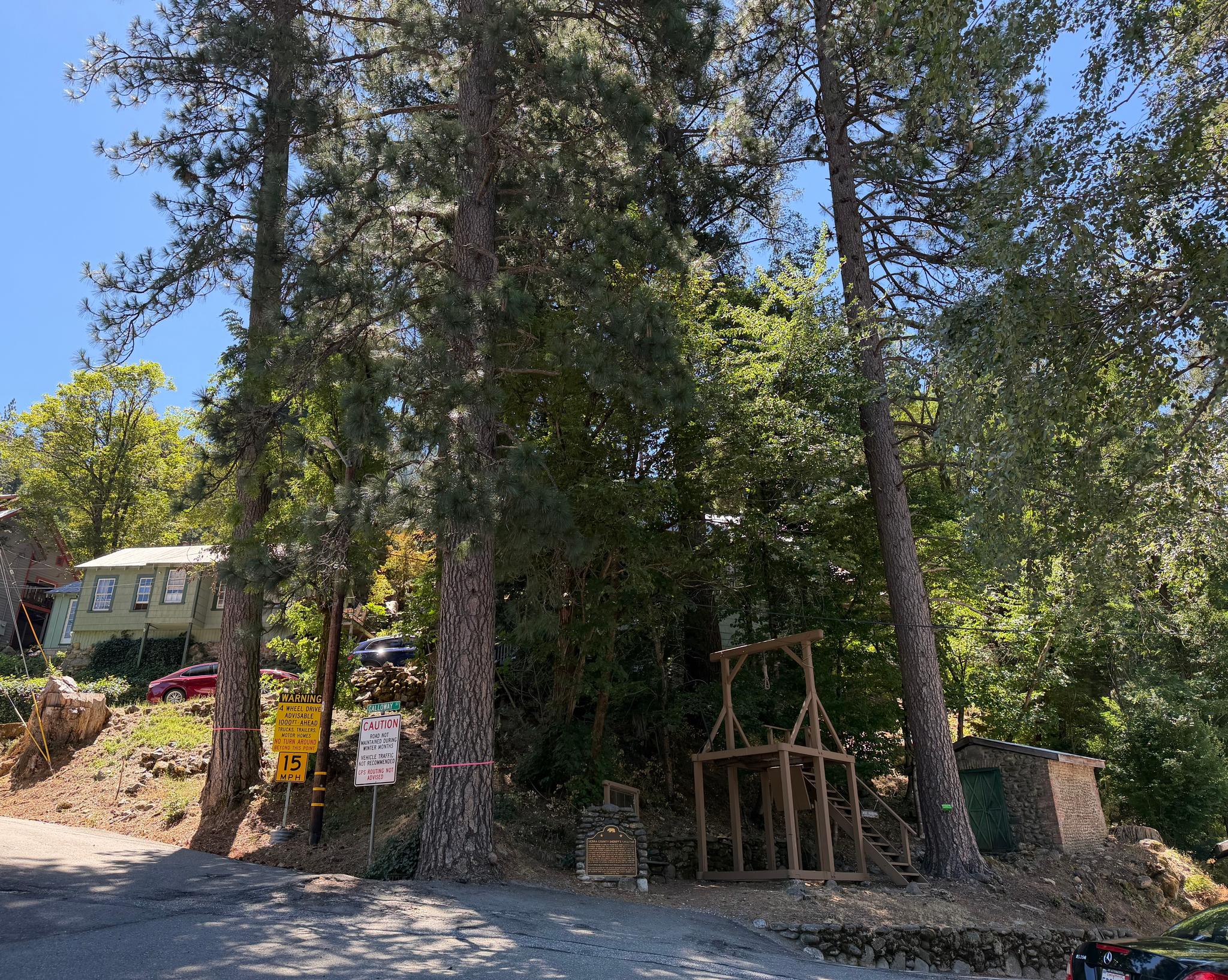
The trees near the Downieville gallows structure discussed in Tuesday’s meeting.
DOWNIEVILLE — Sierra County supervisors stopped short Tuesday of approving work on three large ponderosa pines near the historic Sierra County Sheriff’s Gallows, sending the matter to an ad hoc committee for further review. The discussion centered on possible risks to nearby buildings, the gallows structure, and people working around the courthouse complex. It also raised questions about contractor pricing and how the county should evaluate bids for specialized tree work.
Public Works and Transportation Director Josh Handel told the board the trees are not dead or visibly failing. “These are large, healthy trees,” Handel said. “To be clear, they are not dying.” Even so, he said their size, location, and individual conditions warranted a public discussion about whether cutting or modification is necessary.
Handel described the trees from left to right as viewed from the front of the gallows. The leftmost tree, he said, leans more than 10 degrees and poses a risk to a nearby county building, leading him to recommend removing it. The center tree, directly in front of the gallows, has a split top, and Handel said the board could consider either topping it to remove the split section or removing the tree entirely.
Topping the center tree, Handel said, could buy “another ten, maybe even fifteen years” while reducing the risk to people, property, and the gallows. The third tree, on the right, was described as straight and healthy. Handel recommended leaving it in place for now, while keeping watch because of its proximity to the gallows.
The Sierra County Sheriff’s Gallows are among Downieville’s most visible historic structures. The gallows were used once, for the November 27, 1885, hanging of James O’Neill, the last legal execution in Sierra County. The structure is listed as California Historical Landmark No. 971 and was added to the National Register of Historic Places in 1990.
Handel said the county received three estimates for the removal of all three trees. Misita & Jordan, a local contractor, submitted a $22,000 estimate, broken down as $8,500 for the left tree, $8,000 for the center tree, and $5,500 for the right tree. YFR Tree and Land Management submitted an estimate of $21,235, with about $9,000 attributed to mobilization and no per-tree breakdown.
A third estimate from First Impressions Tree Service came in lower, at $12,400. Handel said he did not recommend moving forward with that company, telling supervisors the firm did not appear to have the same level of responsibility, professionalism, or experience needed for the large trees. He recommended seeking a revised estimate from Misita & Jordan for work limited to the tree on the left and whatever option the board chose for the center tree.
Chair Paul Roen questioned whether the pricing process had become difficult to compare. He said the county had not asked for “apples and apples” from all three contractors, since one estimate was broken down by tree while another included a large mobilization cost. Roen also said asking a contractor to revise pricing after competing estimates had been discussed could leave the county “open to manipulation of the contracts,” and he asked whether each contractor had been given the same insurance requirements.
Supervisor Lee Adams said Handel had spoken with him earlier about the trees, but the decision needed to come before the full board. Adams said he wanted more information about why the issue was being raised now, whether PG&E had any plans involving the trees—two of which have markings on them from an unknown source—and who had determined the trees to be safety hazards. He said he could support removing the leaning tree if it was truly unsafe, topping the center tree, and leaving the third tree alone.
Ultimately, an ad hoc committee was formed to work through the details before the board takes further action.
The discussion turned next to locust trees along Main Street in Downieville. Handel said the proposal there was “much simpler” and did not involve removing any trees. He proposed trimming limbs that touch buildings, including those near the Yuba Theatre, a county-owned facility.
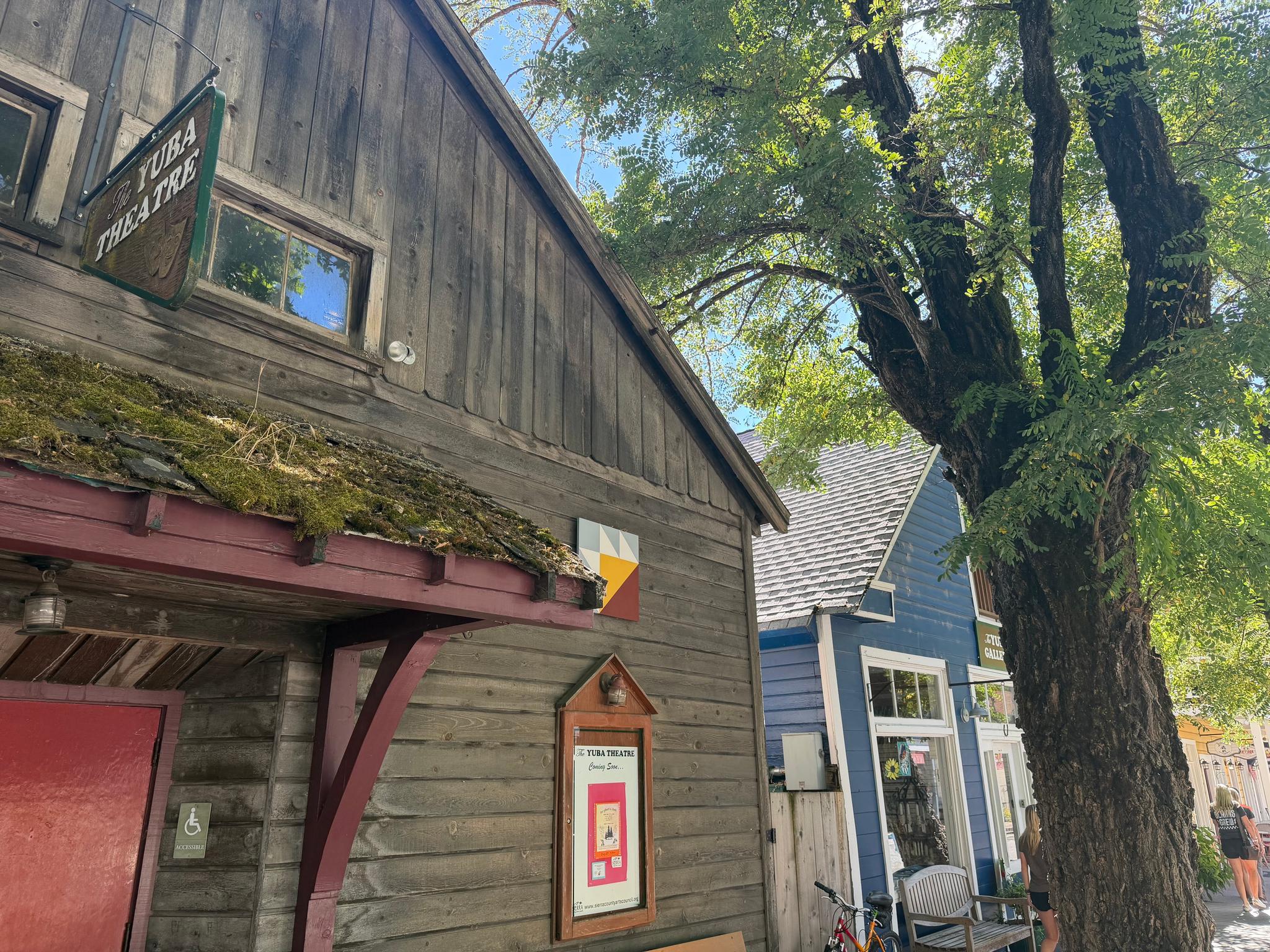
Trees along Main Street are touching buildings, including the historic Yuba Theatre.
Handel said the county had not yet received a formal quote for the Main Street limbing, but he expected the cost to be less than $500. He also used the item to raise a broader question about street trees in the Caltrans right-of-way along Highway 49 and Main Street. He said the locust trees provide shade, help slow traffic, and add character to downtown Downieville, but some may be approaching the end of their useful lives as street trees.
Handel suggested the county consider a future replacement schedule, including the species of trees to plant and an interval for replacing aging trees over time. Adams supported that idea, saying the county would be better served by planning ahead rather than waiting until many of the trees decline at once. “I think we’ve been remiss,” Adams said, adding that a replacement schedule could help avoid losing the downtown tree canopy all at once.
A question was also raised about Caltrans’ role because of the Highway 49 right-of-way. Adams said prior conversations with Caltrans over trees in Downieville had shown the authority question is not always simple. After a brief discussion, supervisors directed Handel to proceed with trimming the Main Street limbs, while leaving the longer-term replacement schedule for a future meeting.