On this page
Grass Valley Settles on Downtown Roundabout Design
Council preserves southbound South Auburn access despite added project costs.
5 min read
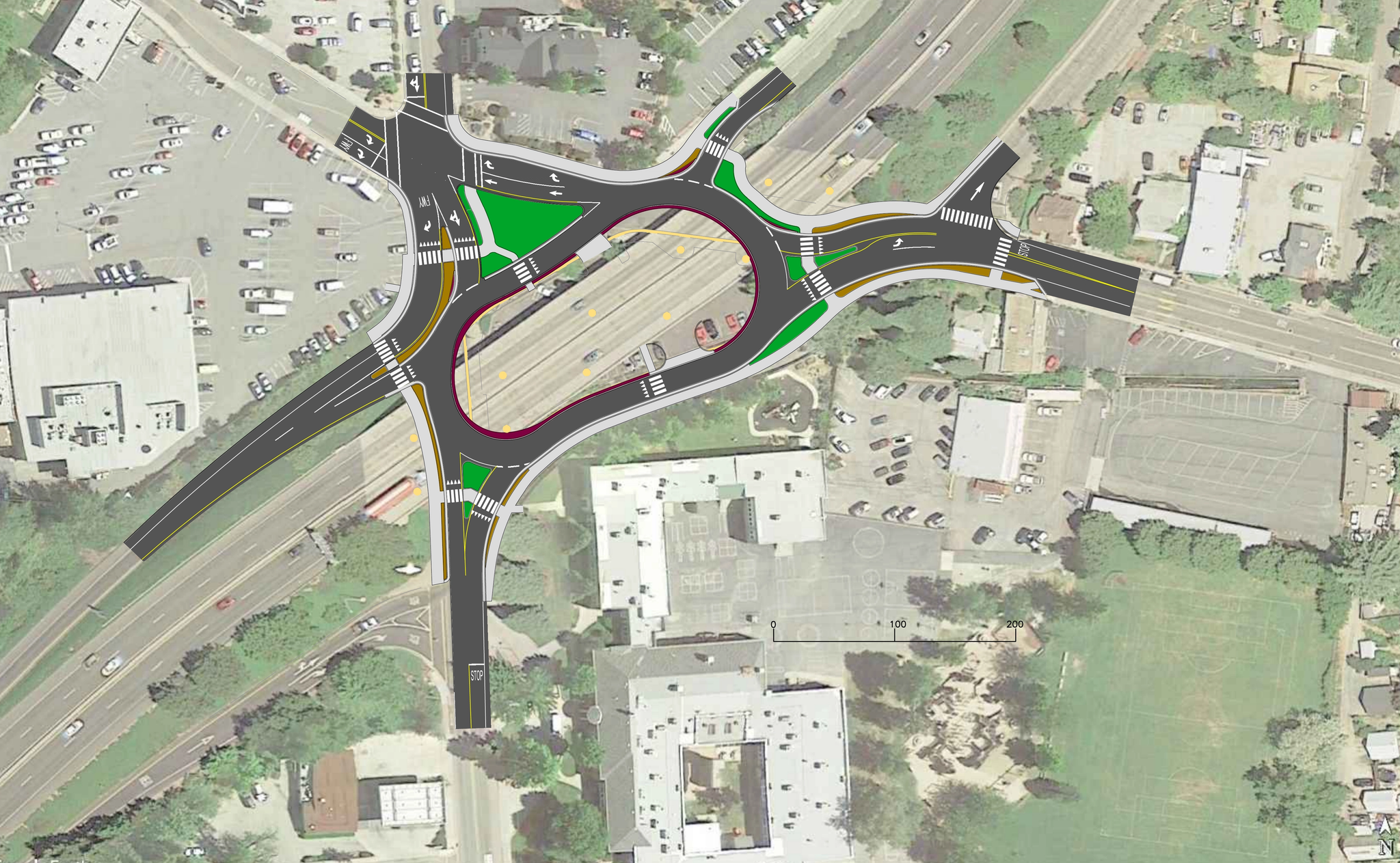
The proposed roundabout design for Grass Valley’s complicated downtown intersection. Credit: City of Grass Valley.
GRASS VALLEY — The City Council selected a design Tuesday for the long-planned roundabout at the southern entrance to downtown, choosing a version with a traffic signal at South Auburn and Neal streets. The signal would preserve a direct route from downtown South Auburn into the roundabout, but the selected design is expected to cost $625,000 to $825,000 more than the alternative recommended by city staff.
The motion passed on a voice vote after more than 90 minutes of presentations, public comment, and council debate during the July 14 meeting. The vote settles the project’s basic layout, but the city must still complete a redesign, secure additional funding, update its environmental review, and obtain more time under a state grant before construction can begin.
A complicated entrance to downtown #
The project would rebuild the area where South Auburn Street, Neal Street, Colfax Avenue, Hansen Way, Tinloy Street, and Highway 49 access converge. The city says a roundabout would improve traffic circulation and provide safer, more direct crossings for pedestrians and bicyclists.
Both designs considered on Tuesday included a roundabout. The central question was how to handle the northwest corner, where South Auburn and Neal meet at a sharp angle beside the proposed roundabout. Engineers said there was not enough public right-of-way to connect both streets directly while meeting roundabout standards.
Two plans for South Auburn #
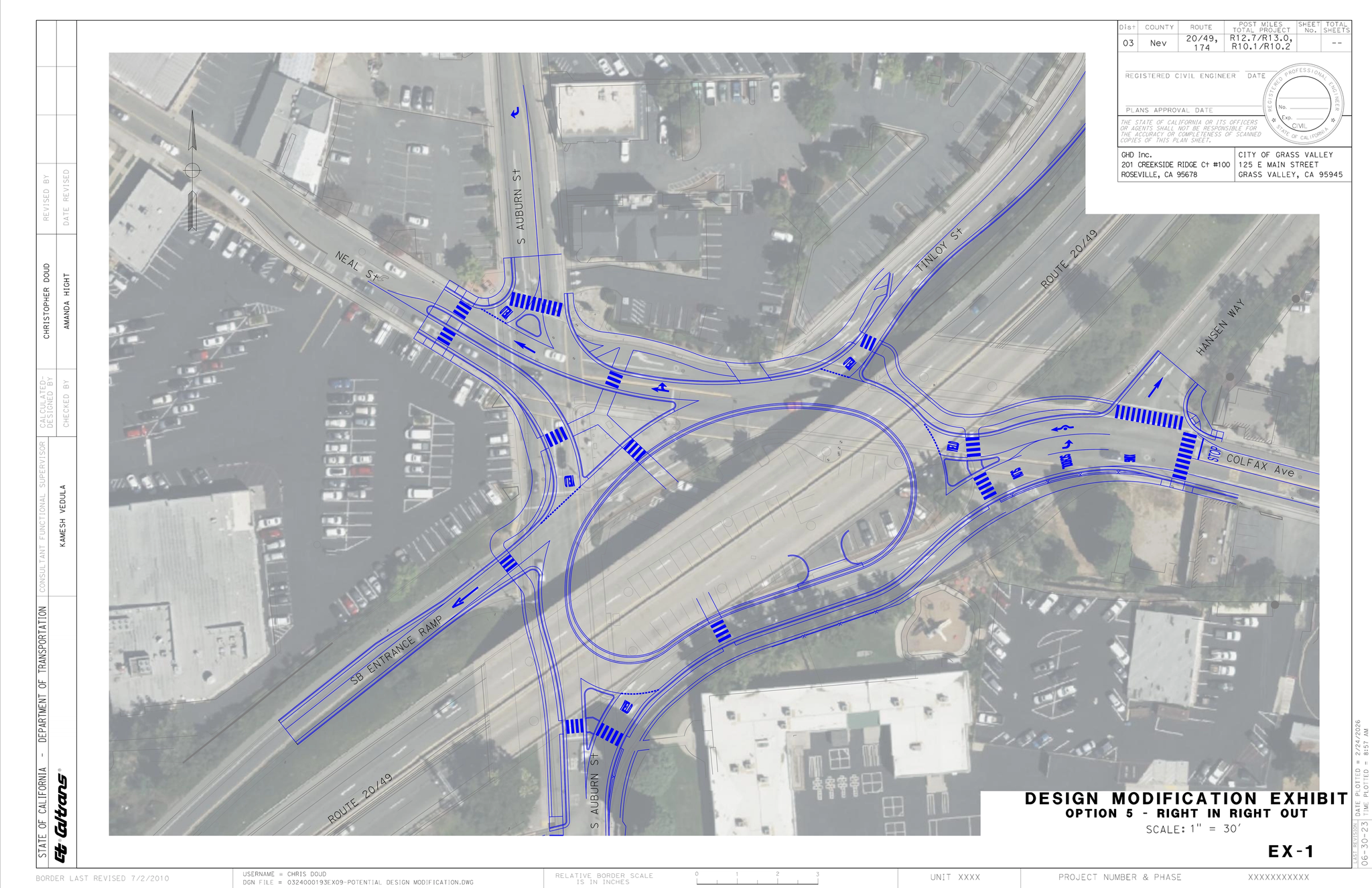
Grass Valley City Staff’s proposed concept, which does not allow southbound South Auburn Street traffic to continue into the roundabout. Credit: City of Grass Valley.
Under the City staff’s recommended design, designated Option 5, drivers traveling south from downtown on South Auburn would have to turn right at Neal rather than continue directly into the roundabout. To reach Highway 49 or continue on South Auburn, they would then need to approach the roundabout from another entrance, most likely via Neal or Tinloy streets.
City Engineer Bjorn Jones said the staff option would create a smaller, simpler roundabout with fewer lanes, conflict points, and driver decisions. It would remove a traffic signal, shortening pedestrian crossings, and reduce the amount of land needed for the project. An analysis by GHD, the city’s engineering consultant, modeled the affected traffic shifting to Neal and Tinloy streets and found that surrounding intersections would continue to operate acceptably during the peak periods studied.
The council instead selected Option 1, a design that keeps a signal at South Auburn and Neal, allowing southbound traffic to continue into the roundabout, and adds a dedicated lane from Neal Street to southbound Highway 49. The signal would change more quickly than a conventional intersection signal, operating more like a freeway ramp meter.
Option 1 requires more lanes, merges, and retaining walls along a widened Highway 49 on-ramp. Staff warned that vehicles waiting at the signal could back into the roundabout or queue farther up Neal Street, while the additional lanes could make the intersection more confusing for drivers.
Why the council chose Option 1 #
Much of the public comment favored keeping the direct connection from downtown South Auburn. Business and property representatives said Option 5 could send unfamiliar drivers onto Neal Street or into nearby parking lots as they searched for another route. Speakers also raised concerns about downtown events, emergency evacuations, and heavy trucks. A representative of a local materials company said Option 5 could divert as many as 150 truck trips per day through the Brunswick area during peak construction season.
Supporters of Option 5 said its shorter crossings, lower vehicle speeds, and fewer conflict points would make the intersection safer and easier to navigate. A representative of a local bicycle organization argued that removing the signal would better accommodate people walking and riding bicycles.
Police Chief Alex Gammelgard told the council that officers could manage an evacuation under either design, but Option 5 would require more officers and traffic-control points to move downtown traffic toward the freeway. Option 1’s two Neal Street lanes and direct route from South Auburn would be easier to manage, he said.
Mayor Hilary Hodge questioned whether traffic modeling based on peak commuting periods adequately reflected crowded downtown events or the behavior of drivers unfamiliar with the area. She favored Option 1 as a more practical fit for those conditions.
Vice Mayor Haven Caravelli supported Option 5, arguing that removing the signal would reduce downhill backups on Neal Street. She called eliminating the signal the “single best thing” the city could do at the intersection and warned that Option 1 might provide only a marginal improvement over current congestion.
Arbuckle said preserving the South Auburn route would work better for the community and called Option 1 the “better design for the flow of traffic.” Her motion passed after regional transportation officials said additional funding might be available and a five-month extension of the state grant deadline appeared obtainable. Neither had been approved as of Tuesday.
Higher cost, funding not yet secured #
The city’s staff report estimates construction of Option 5 at $5.64 million. Adding the signal, a second on-ramp lane, retaining walls, and a larger project footprint puts the preliminary construction estimate for Option 1 between $6.14 million and $6.34 million.
Revising the design would cost another $125,000, bringing the total estimated increase over Option 5 to between $625,000 and $825,000. About $5.48 million in construction grant funding is currently available, and the city had not secured money for the added cost before the vote.
Nevada County Transportation Commission Executive Director Mike Woodman said regional air-quality funds or federal carbon-reduction money could be considered. Either source would require approval by the transportation commission and would compete with other regional projects.
Redesign pushes back the schedule #
The city has until September 30 to complete the project approval and environmental work required by its principal state grant. Because Option 1 cannot be redesigned by then, the city must request a five-month extension from the California Transportation Commission through February 28, 2027. Commission staff has indicated support, according to Woodman, but the extension still requires a public hearing and formal approval.
GHD and city staff must now update the engineering studies, drawings, and environmental documents. Staff also plans to return to the council with a contract amendment for the redesign and a proposal for covering the higher cost.
Missing the extended deadline could cost the city $5.23 million in future Active Transportation Program funds and could require repayment of approximately $500,000 already spent. If the extension, funding, and state approvals remain on track, final engineering is expected to continue through much of 2027, with construction anticipated in the 2027–28 funding year.