Nevada County Approves Truckee Fuel Break Partnership
Nearly 300 acres near Highway 89 are slated for treatment.
4 min read
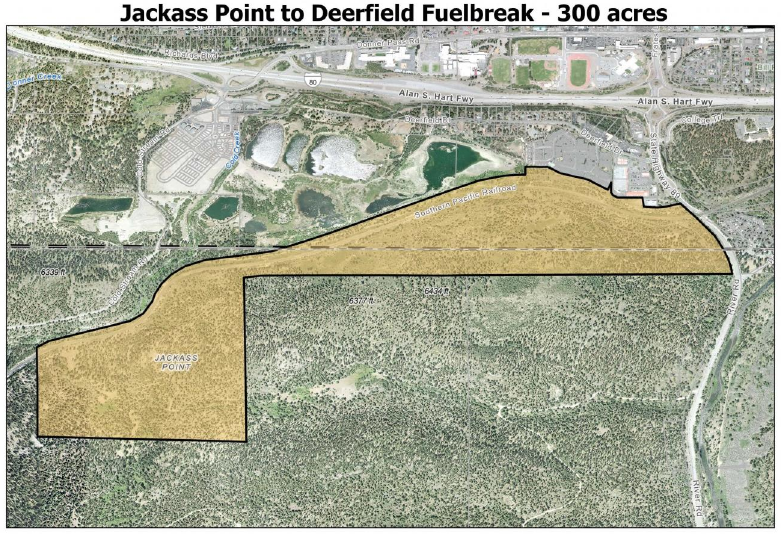
The proposed Jackass Point-to-Deerfield fuel break project area. Map courtesy of Nevada County Office of Emergency Services and Truckee Fire Protection District.
TRUCKEE — A nearly 300-acre fuel break planned between Jackass Point and Deerfield moved closer to implementation Tuesday when the Nevada County Board of Supervisors unanimously approved a $949,750 interagency partnership. The 5-0 vote authorized a Good Neighbor Agreement between the county Office of Emergency Services and the U.S. Forest Service’s Tahoe National Forest. The agreement combines $604,750 in federal reimbursement funding with a $345,000 match from the Truckee Fire Protection District.
The project area lies on private, non-federal land southwest of central Truckee, extending east from Jackass Point toward Highway 89 along the south side of the railroad corridor. It borders Tahoe National Forest and would extend the recently completed Cabin Creek fuels project toward the Coldstream, Deerfield, and Truckee Crossroads communities. County documents identify the nearby stretch of Highway 89 as a traffic constriction and critical evacuation route for Truckee and Tahoe residents.
District 5 Supervisor Hardy Bullock said the mapped treatment area is behind the Truckee Navigation Center, Coldstream Commons, and a new Coldstream neighborhood under construction. “So it’s an area of a lot of activity, and I think it’s going to be a great addition to the work that’s going on in that community,” Bullock said.
The listed treatment is selective, focusing on small trees generally less than 16 inches in diameter and on ladder fuels—the brush, low branches, and young trees that can carry flames from the ground into the forest canopy. Plans call for mechanical thinning, mastication, limbing, chipping, and biomass utilization. In practical terms, crews and heavy equipment would thin dense stands, remove lower branches, grind or chip brush and smaller trees, and sort usable wood for sale or energy production.
Reducing the amount and continuity of combustible vegetation is intended to lower potential fire intensity, help protect neighboring homes and infrastructure, and give firefighters a better opportunity to slow a fire. The work would not create a treeless strip or guarantee that a wildfire could not cross the area. Truckee Fire plans to permit the commercial forest-management project under a CAL FIRE Forest Resilience Exemption.
The project’s financial plan allocates $600,000 in federal funds for treatment on 150 acres at an estimated $4,000 per acre, plus $4,750 for county project management. Truckee Fire’s $345,000 match would cover an additional 150 acres at an estimated $2,300 per acre. Federal funds would be paid on a reimbursement basis, and the county budget amendment would add equal amounts of federal revenue and project expenses to the Office of Emergency Services budget.
Truckee Fire’s contribution would come from Measure T, the $179 annual parcel tax approved by district voters in 2021. The tax generates approximately $3.7 million a year for wildfire-prevention work in the Truckee and Donner Summit wildland-urban interface. Truckee Fire has used the local revenue to attract grants and matching contributions from other land managers.
Tuesday’s approval does not by itself send contractors into the forest. The county’s emergency services director must execute the federal agreement, and the agreement’s formal start date will be the Forest Service’s signature date. The Office of Emergency Services must then return to supervisors with a separate agreement making Truckee Fire the subrecipient and primary project implementer.
Truckee Fire forester Dillon Sheedy said the district hopes to move considerably faster than the federal agreement’s 2035 expiration date. “Our goal here is to have this project completed by next year,” Sheedy said. “We’re going to start working on it pretty hard here this fall and hopefully have a contract out to get this work done in 2027.”
The agreement allows the partners to add project areas or new funding through subsequent modifications, subject to additional approvals. It also states that costs and revenue are estimates and that work could be delayed or dropped if available funding proves insufficient.
The board’s discussion also ranged beyond the listed project activities to prescribed burning and limited herbicide use as broader forest-management tools. Truckee District Ranger Jonathan Cook-Fisher said prescribed fire is generally preferred but depends on suitable weather and available crews, while any herbicide use would be targeted and evaluated for a specific site. Herbicide application is not among the activities listed for the Jackass Point-to-Deerfield project.
The new agreement is Nevada County’s third Good Neighbor Agreement with Tahoe National Forest. A 2024 east-county agreement assembled $301,000 and treated 110 acres of roadside hazardous fuels, while a 2025 west-county agreement secured $1.74 million and treated 364 acres, according to the county’s presentation. Both relied on local contractors.
County staff will next prepare the implementation agreement with Truckee Fire for a future Board of Supervisors vote. Project contracting, final field planning, landowner coordination, and the CAL FIRE exemption process would follow before treatment begins.