Sheriff’s Radio Upgrade Strengthens Dispatch Operations
A new console replaces failing equipment and streamlines communications.
5 min read
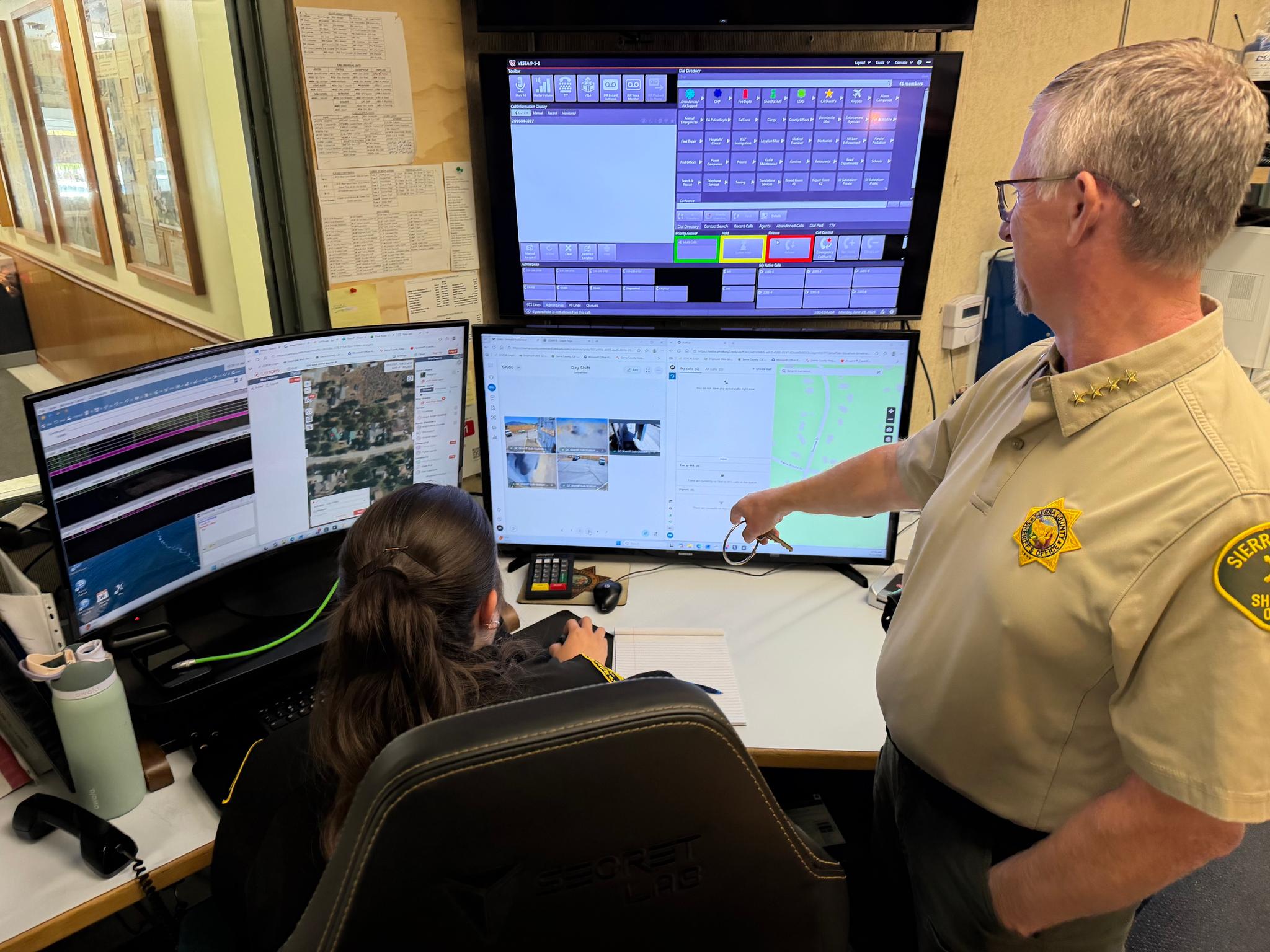
Sheriff Fisher and Officer Whitley showcase Sierra County’s dispatching setup.
DOWNIEVILLE — When someone calls 911 in Sierra County, the call usually lands at the Sierra County Sheriff’s Office in Downieville, where dispatchers determine the location, identify the emergency, and send the appropriate response. During a tour and interview this week, Sheriff Mike Fisher and dispatcher Emma Whitley showed how the office’s dispatch center brings together call-taking, radio traffic, mapping, security monitoring, and emergency communications.
The dispatch center has been upgraded with four large screens and a radio monitor, replacing a smaller setup that Whitley said once consisted of one shelf and two monitors used for phones and mapping. One screen area gives dispatchers access to camera feeds from county and court facilities, including the courthouse, sheriff’s substation, Health and Human Services building, and the Sierra City transfer site. Whitley said the cameras help staff monitor facilities, check conditions, and review past footage for vehicles or activity when needed.
Other screens handle the phone side of dispatch. Fisher said a 911 call populates information commonly known as ANI/ALI, or automatic number and location information. For landline calls, that can include the phone number and physical address. Cellular calls can display a caller’s GPS location on a map, depending on phone and tower information, giving dispatchers a starting point when a caller is mobile or unsure of their location.
The newest change is the Sheriff’s Office radio console, a Motorola/Avtec system that replaced older equipment used to talk with deputies and other agencies. Whitley said the new setup is “a lot more user-friendly,” especially after the Sheriff’s Office took over Downieville Fire dispatching earlier this year. Instead of relying on a small secondary radio and several button presses, dispatchers can now select the fire channel, tone out responders, and speak through the console in seconds.
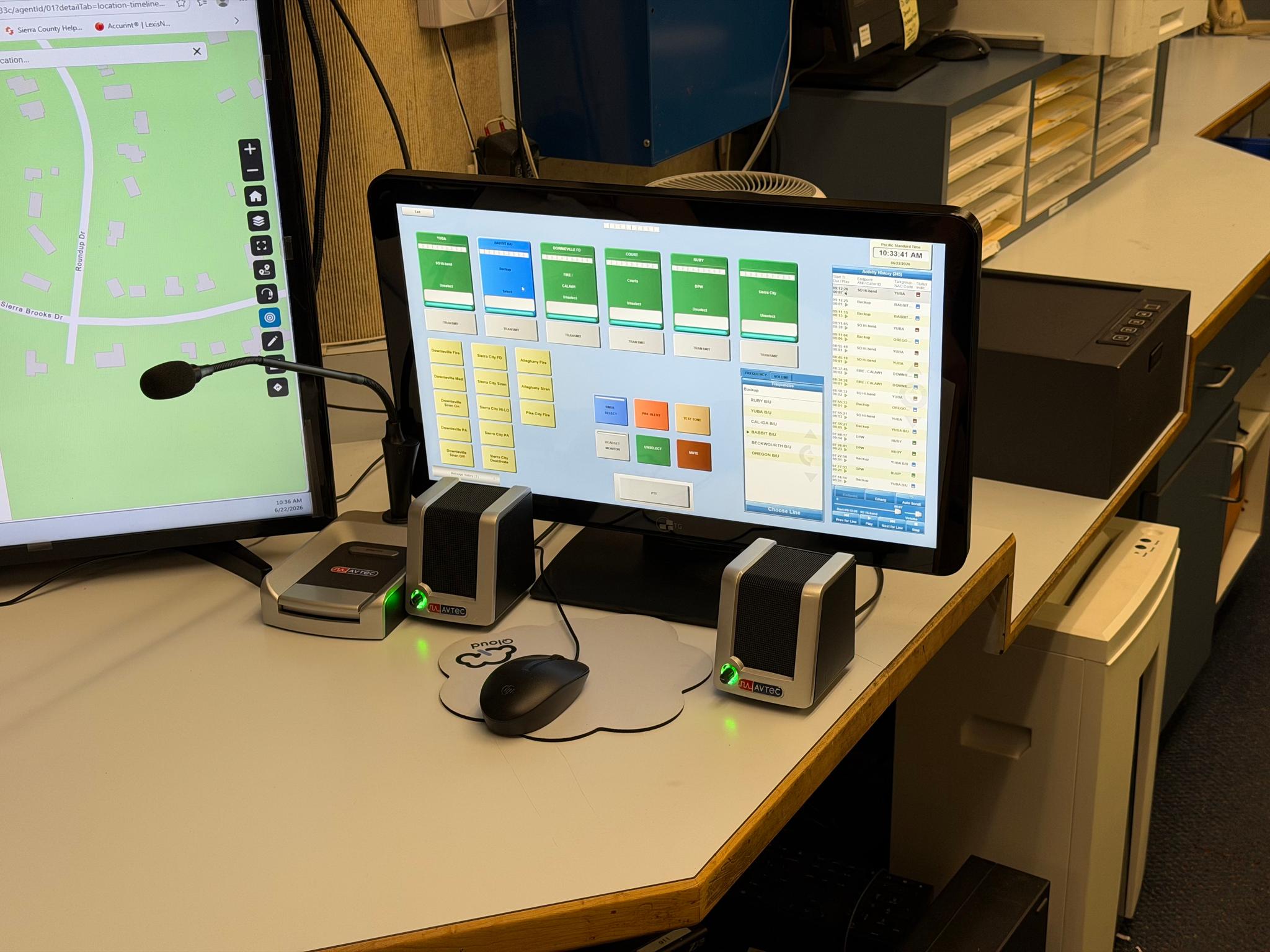
The radio console, pictured here, is the dispatcher’s interface with the Sheriff’s upgraded radio system.
The console also gives dispatchers a clearer way to handle daily sheriff’s office radio traffic. Channels are displayed on the screen, allowing dispatchers to quickly select the repeater or agency they need, rather than scroll through an older, more complex interface. Whitley said the system records transmissions, allowing dispatchers to replay unclear radio traffic rather than ask a deputy to repeat information.
The new system has also expanded what dispatchers can hear. Whitley said the console allows the Sheriff’s Office to monitor county road department radio traffic, which has already been useful. Instead of waiting for road crews to reach phone service and report an issue, dispatchers can hear some information earlier as crews talk to each other. The system also allows for broadcasting on road department channels if necessary.
Fisher said the old radio console had reached a point where failure was no longer theoretical. The system ran on Windows Vista with proprietary software no longer supported by the manufacturer, he said. Twice, the office had to send console computers to a Sacramento radio technician, who disassembled the machines, ordered replacement parts from eBay, and soldered repairs onto the motherboards.
“When I went to the board to get this put into the budget, I said, ‘Look, it could be ten minutes from now, it could be occurring as we’re speaking, or it could be in a year, but our radio system is going to fail,’” Fisher said.
The Sierra County Board of Supervisors unanimously approved the Motorola agreement on October 7, 2025, for an amount not to exceed $178,931.47. The Sheriff’s Office sought quotes for the console replacement and, after receiving two qualified responses, recommended Motorola. Fisher’s memo to the board said Motorola’s bid was lower and included installation by an authorized dealer, ongoing support, software updates, preventative maintenance, and emergency service response.
The quote included two Scout EX consoles, console computers, touch-screen monitors, foot switches, headset and handset equipment, desktop microphones, speakers, radio gateways, three APX consolettes, software maintenance, and system installation. Together, those pieces replaced equipment that had become increasingly difficult to repair and support. The system became operational in April.
The new console does not eliminate the complicated geography behind Sierra County radio traffic. Fisher gave the example of a deputy in Loyalton selecting the Babbitt repeater, sending the signal to Babbitt Peak, then across to Ruby Bluff, on to the Cal-Ida repeater, through telecommunications lines, into Downieville, and finally downstairs into the courthouse communications room before coming out of dispatch speakers. A dispatch transmission back to the deputy follows the same path in reverse.
Fisher said the next communication work is less dramatic than the console replacement but still important. Equipment at Ruby Bluff and Cal-Ida is aging, and the county plans to clean up and modernize parts of the system. He said a full microwave project to move the system away from phone-line dependence was not feasible at this time, as it would likely cost more than $1 million.
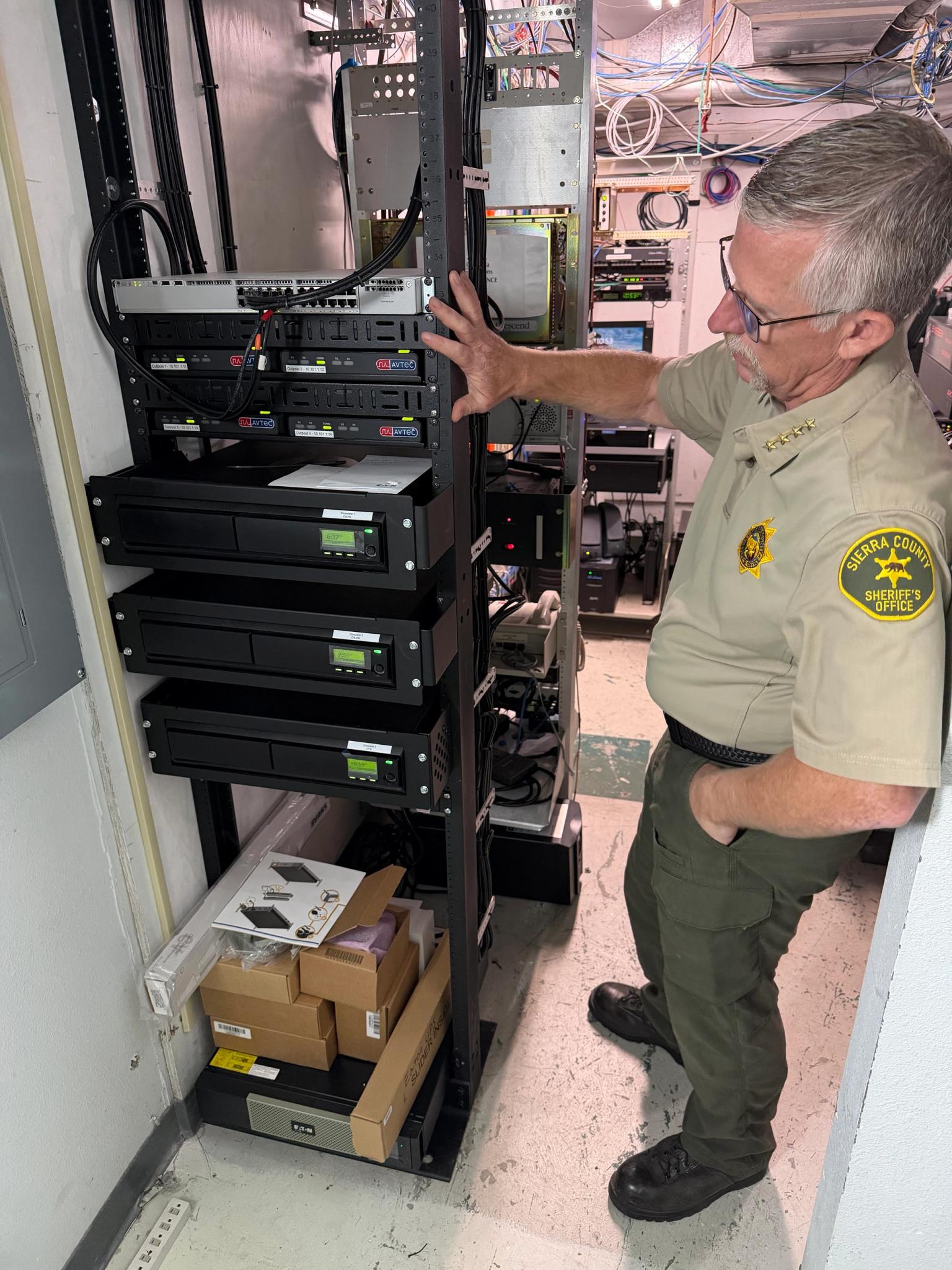
The Motorola radio computers and switching units now in operation.
Downstairs in the courthouse communications room, Fisher showed the equipment behind the dispatch screens. A new rack now houses the radio controls and multiple radios programmed to different frequencies, replacing stacks of older equipment tied to the previous console. Nearby equipment also supports the county’s 911 call system, jail controls, backup power, and emergency workarounds.
The Sheriff’s Office is also expanding its portable radio inventory. Fisher said the Truckee Police Department provided Sierra County with more than 30 handheld radios, some in near-new condition, after Truckee had to purchase new equipment connected to Nevada County’s radio upgrade.
Because the radios themselves were obtained at little cost, Fisher said money previously budgeted through a search-and-rescue grant could instead be used for batteries, lapel microphones, chargers, and a charging bank for the command trailer. The radios are being programmed for deputies, county disaster workers, and a developing large animal rescue group that could assist during evacuations. Fisher said the radios will be kept in a cache, charged and ready to issue when needed.
For Fisher, upgrades are about making sure dispatchers and deputies have reliable tools when an emergency call comes in. In a county where radio traffic may cross mountaintops, phone lines, fiber connections, and aging repeater sites before reaching a dispatcher’s headset, every small improvement can make a difference.