
CDFW Publishes Latest Gray Wolf Monitoring Updates for 2026
Reports document twelve active packs and highlight activity in the Sierra Valley and far northern counties.
2 min read
CALIFORNIA — The California Department of Fish and Wildlife posted three new documents to its gray wolf webpage on April 28. The materials include the Quarterly Wolf News covering January through March 2026, an updated version of California’s Known Wolves for March 2026, and a revised Approximate Area of Gray Wolf Activity map through March 2026. The reports summarize pack status, dispersing wolves, livestock interactions, compensation payments, and public outreach efforts across the state.
CDFW currently recognizes twelve distinct wolf packs. The agency does not provide a statewide population total in these documents, but the presence of multiple breeding pairs, recent litters, and 13 actively collared wolves suggests an expanding population. Most packs occupy territory in far northern California, with one established group farther south in Tulare and Kern counties.
Distribution remains concentrated in Siskiyou, Modoc, Shasta, Tehama, Lassen, Plumas, and Sierra counties. In the Sierra Valley region, the Long Valley pack ranges across eastern Sierra County, eastern Plumas County, and southern Lassen County. Genetic testing confirmed at least two wolves in that area into early 2026, including one female from a prior litter associated with the Beyem Seyo group.
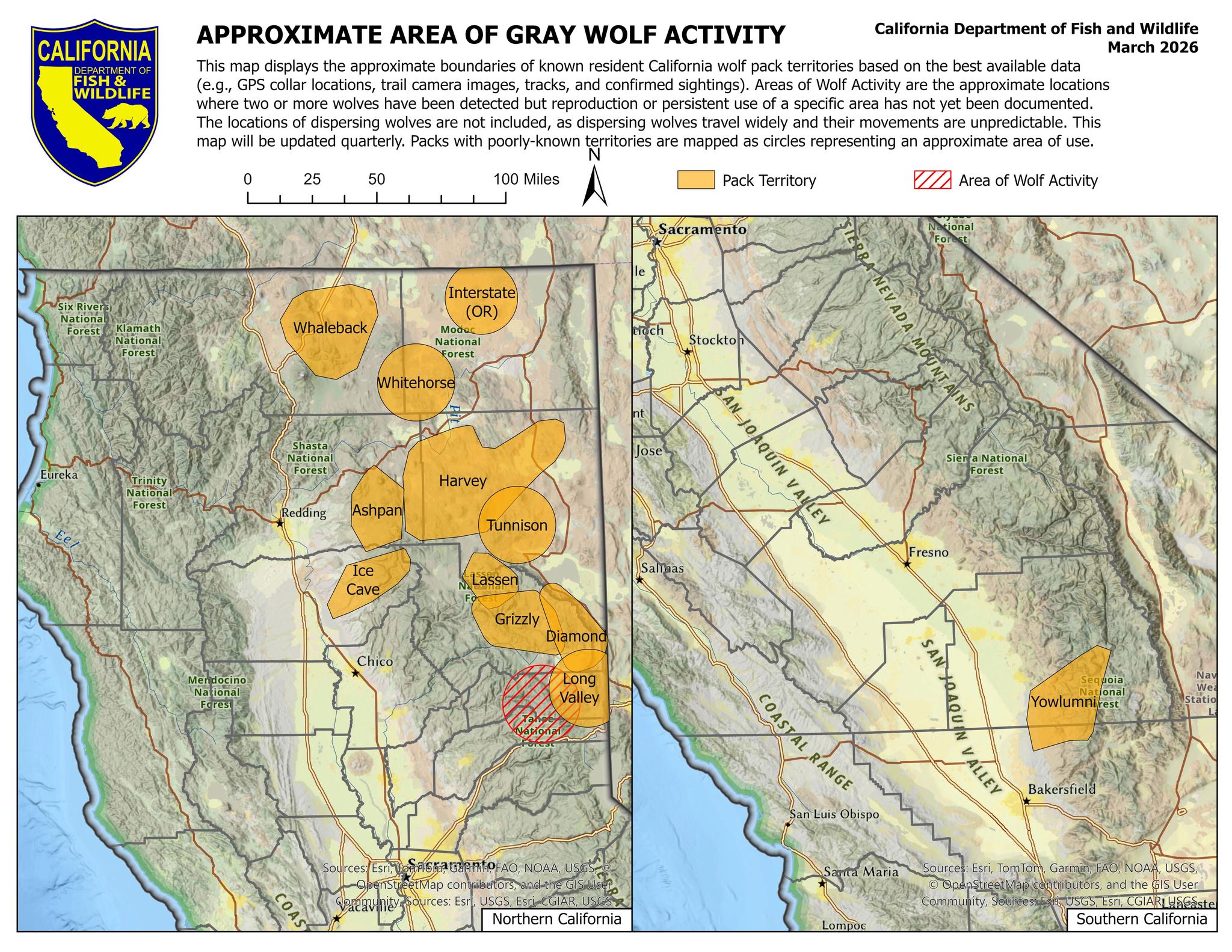
CDFW’s gray wolf activity pack for March of 2026.
CDFW identifies three newly recognized packs. The Interstate pack occupies northern Modoc County near the Oregon border. The Whitehorse pack has been consistently detected since August 2025 in western Modoc and eastern Siskiyou counties. The Long Valley pack, already noted above, was formally added based on six months of camera, track, and genetic evidence. Earlier reports listed nine packs; the current total stands at twelve.
During January through March 2026, CDFW opened forty-seven depredation investigations. Thirteen losses were confirmed as wolf-related, and six were classified as probable. The Whaleback pack in eastern Siskiyou County accounted for ten confirmed and four probable cases. Other packs recorded fewer or no confirmed losses during the quarter. The Wolf-Livestock Compensation Program paid $179,687.10 to ranchers for twenty applications received in that period, with seven more under review.
CDFW staff conducted helicopter collaring operations in January, adding several new satellite collars. Dispersing wolves from established packs traveled through multiple northern counties and briefly into Oregon or Nevada before some returned. Public reports of sightings continue to help biologists track movements and identify new activity zones. The agency held numerous meetings with county officials, livestock groups, and conservation partners throughout the first quarter to share data and discuss conflict reduction.
Full documents and more information are available on CDFW’s gray wolf webpage.