On this page
Colgate Recovery Advances as Crews Clear River Sediment
Powerhouse will stay offline for years as sediment removal continues.
7 min read
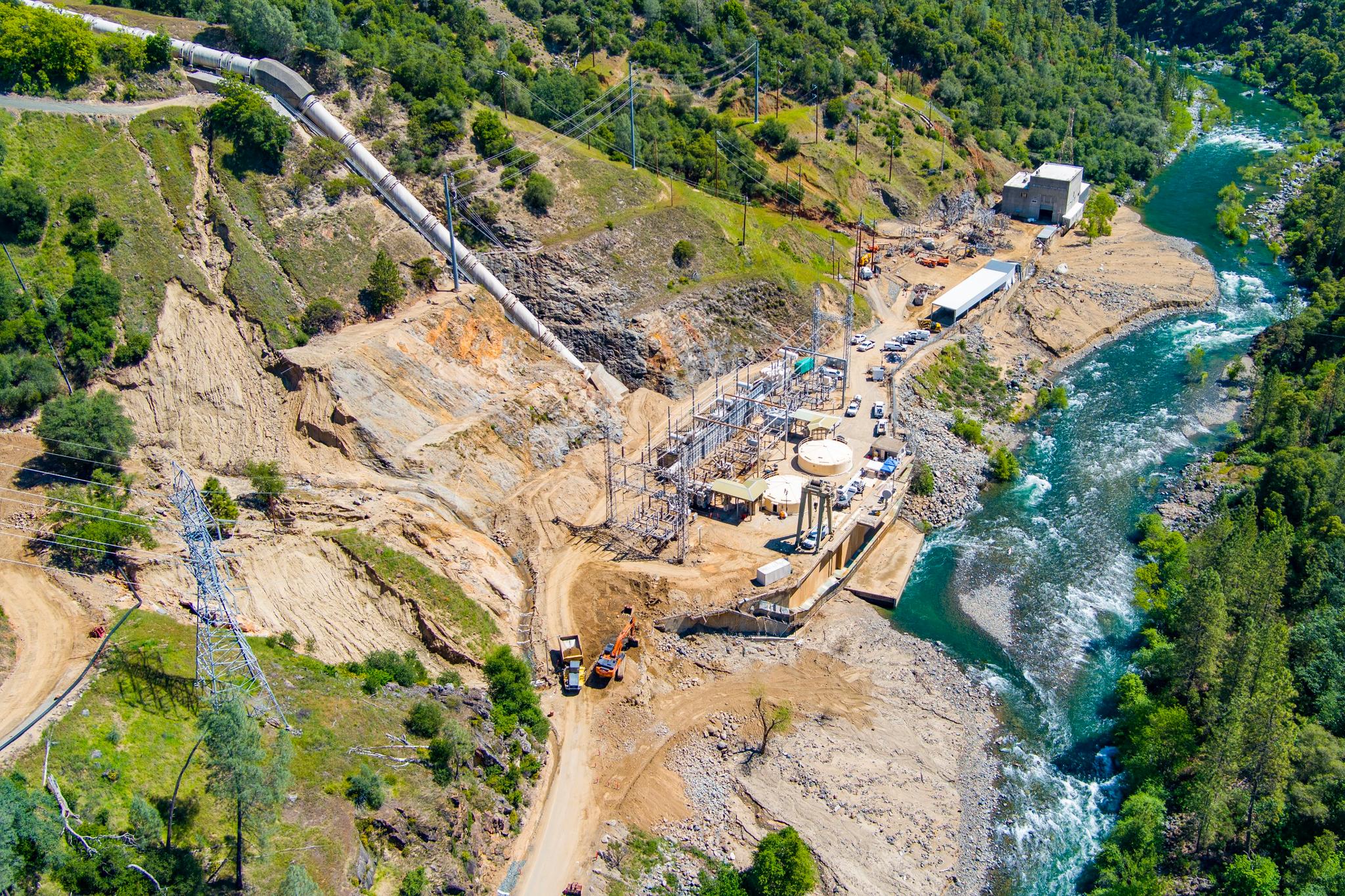
Crews work to remove tens of thousands of cubic yards of sediment around the New Colgate Powerhouse on the North Yuba River. Photo: Alex Boesch/Yuba Water Agency.
DOBBINS — More than five months after a ruptured pipe sent a wall of water down the hillside above the New Colgate Powerhouse, excavators are still working the banks of the North Yuba River, pulling out the tens of thousands of cubic yards of mud and rock the failure left behind. In a video posted this week, the Yuba Water Agency showed the work underway and explained how it is watching the river while crews dig.
Yuba Water has called the February 13 failure one of the biggest challenges in its modern history. Just before 3 PM that day, the 14-foot-diameter penstock that carries water from New Bullards Bar Dam down to the powerhouse ruptured during testing of a newly installed protective valve, part of a tunnel and penstock upgrade begun in September 2025. About 400 acre-feet of water stored in the five-mile rock tunnel and one-mile penstock rushed down the slope, flooding the powerhouse, eroding the hillside, tearing out sections of Lake Francis Road, and carrying sediment, debris, and oily material into the river above Englebright Lake.
Five workers had to be evacuated from the site, and one, a contract employee, was seriously injured and hospitalized in intensive care after a Cal Fire helicopter completed the rescue from below the powerhouse at 6:18 PM. The release also flooded a Pacific Gas and Electric Company switching station south of Dobbins, cutting power to more than 15,000 customers in Yuba, Sierra, Nevada, and Butte counties, and Yuba County proclaimed a local emergency a week later. The Mountain Messenger reported on the rupture and the first days of cleanup in February.
Digging the river back out #
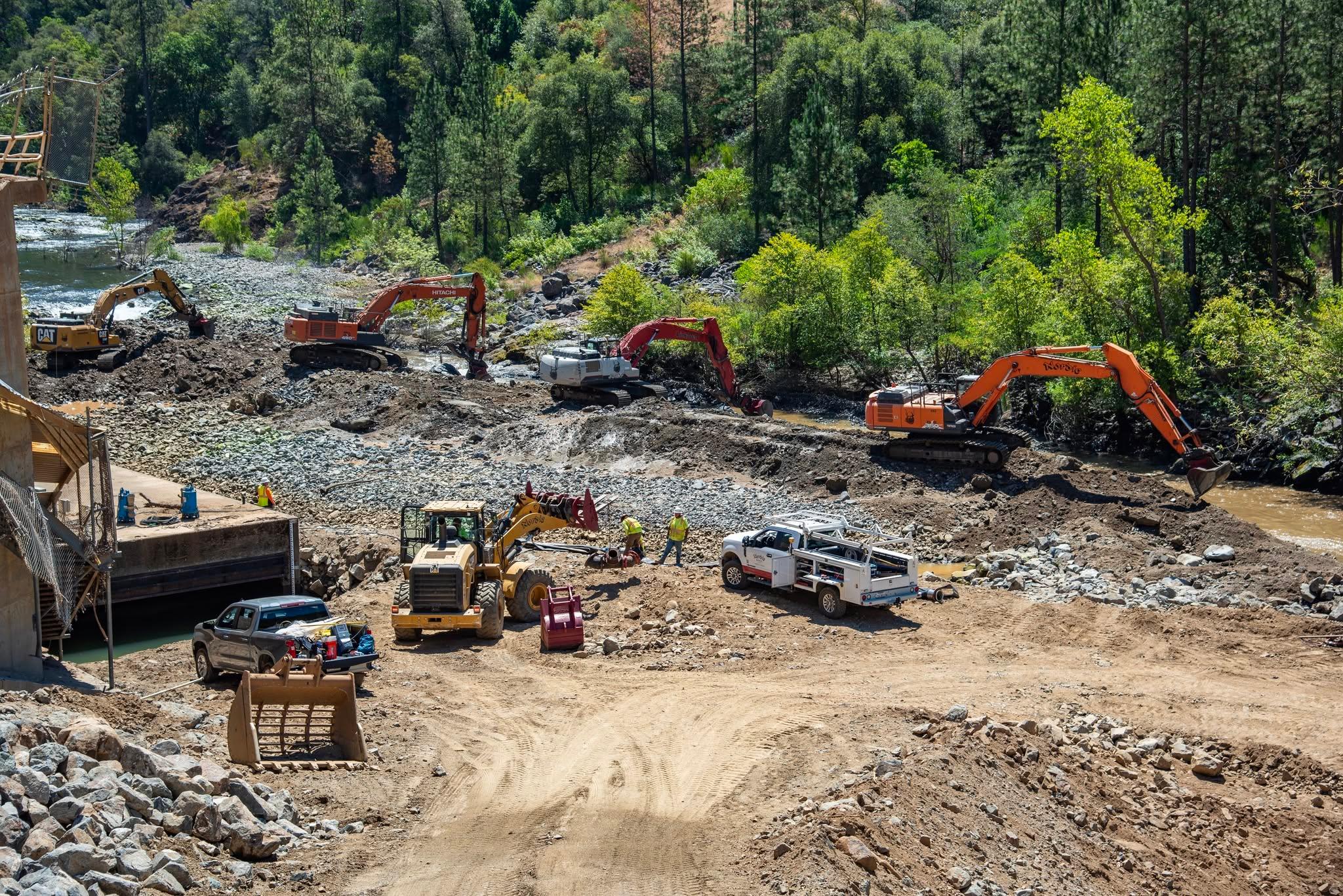
Excavators remove sediment from the riverbank below the New Colgate Powerhouse. The agency says the work causes temporary cloudiness in the river. Photo: Alex Boesch/Yuba Water Agency.
Roughly 60,000 cubic yards of sediment washed into the river, settling into large fans on either side of the powerhouse; about 49,000 cubic yards upstream and another 11,000 downstream, by the agency’s estimate. Removal along the riverbank began in May and is scheduled to continue into August. The contractor, Yuba County-based Nordic Industries, is also rebuilding Lake Francis Road.
Yuba Water says taking the material out now, under controlled conditions, is necessary both to restore powerhouse operations and to return the river channel to its normal capacity before winter flows arrive. Left in place, the agency says, high water could move the sediment downstream unpredictably.
“Unfortunately, the river and Englebright Lake may look murkier over the next few weeks, while we work through this process,” General Manager Willie Whittlesey said when the agency announced the riverbank work. “But, by removing this sediment right now, in a controlled way, we can continue to support recovery at the site and reduce the chance of further environmental impacts during high-flow events in the future. This work is about taking action now to reduce future risks.”
Watching the water #
The video features environmental scientist Shawn Spani, who described the monitoring that runs alongside the excavation. Crews take turbidity readings three times a day while in-channel work is underway — before work begins, at midday, and after crews finish — and Spani collects jars of water that go to a laboratory for analysis.
The samples are tested for contaminants that could have entered the waterway, including gasoline, diesel, and oils. “We have been doing water quality monitoring since the incident,” Spani said. “We haven’t had any detections in our water samples so far for any contaminants.”
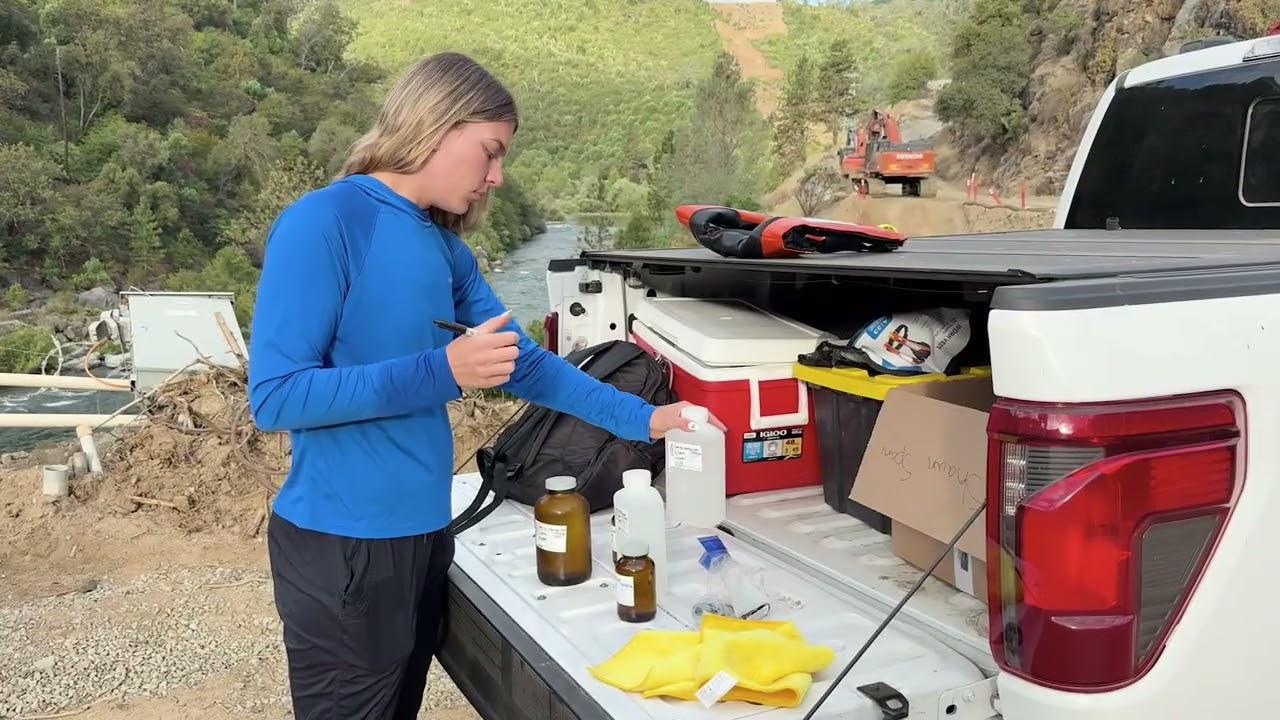
Yuba Water environmental scientist Shawn Spani prepares water samples for laboratory analysis at the New Colgate Powerhouse site. Photo: Yuba Water Agency.
Turbidity is the more visible effect. “It doesn’t take much for the water to start to look a little murky,” she said, noting that natural storms produce the same effect. There is a chance the cloudiness will be visible downstream at Englebright Lake, she said, “but we’re going to do our best to manage levels and keep them as low as possible for wildlife as well as recreators.”
The agency says samples of the sediment being removed have tested within acceptable ranges, and that independent laboratory testing has not detected concerning levels of petroleum hydrocarbons, PCBs, or volatile organic compounds. Monitoring immediately after the rupture showed elevated turbidity, while temperature, dissolved oxygen, and pH stayed within normal ranges.
An outside group has been taking its own measurements since February. The South Yuba River Citizens League began sampling about 18 hours after the failure and recorded turbidity of 59.5 Nephelometric Turbidity Units at Rice’s Crossing, downstream of the incident, against 1.21 units at a control site at Bridgeport on the South Yuba. Readings at Rice’s Crossing peaked near 67 units on February 19. Below Englebright Dam, the group documented nine days of elevated turbidity, between 31 and 99 units, from February 18 to February 26, and noted that sustained levels above 20 units are known to harm salmon and steelhead.
The group also documented hundreds of juvenile salmon stranded and killed in the lower Yuba River when flows dropped abruptly after the rupture, and said the toll across the 24 miles of the lower river was likely in the thousands. Yuba Water attributes the drop to a loss of power at the Narrows 2 Powerhouse during the emergency response and says flows were restored within several hours. No oily debris or incident-related material moved below Englebright Dam, according to the agency. Emergency debris and oily material cleanup, carried out under a unified command with the California Department of Fish and Wildlife, finished on March 6, and Englebright Lake reopened to recreation in mid-March.
Inside the powerhouse, and up the hill #
Mud and debris on the deck above the powerhouse stood more than 13 feet deep in places, and crews have hauled off approximately 11,000 cubic yards. The building’s interior was not fully inundated, and staff has been cleaning and testing systems and circuits inside, with many critical systems already restored. Initial inspections of the five-mile Colgate rock tunnel found it in good condition, needing only minor repairs.
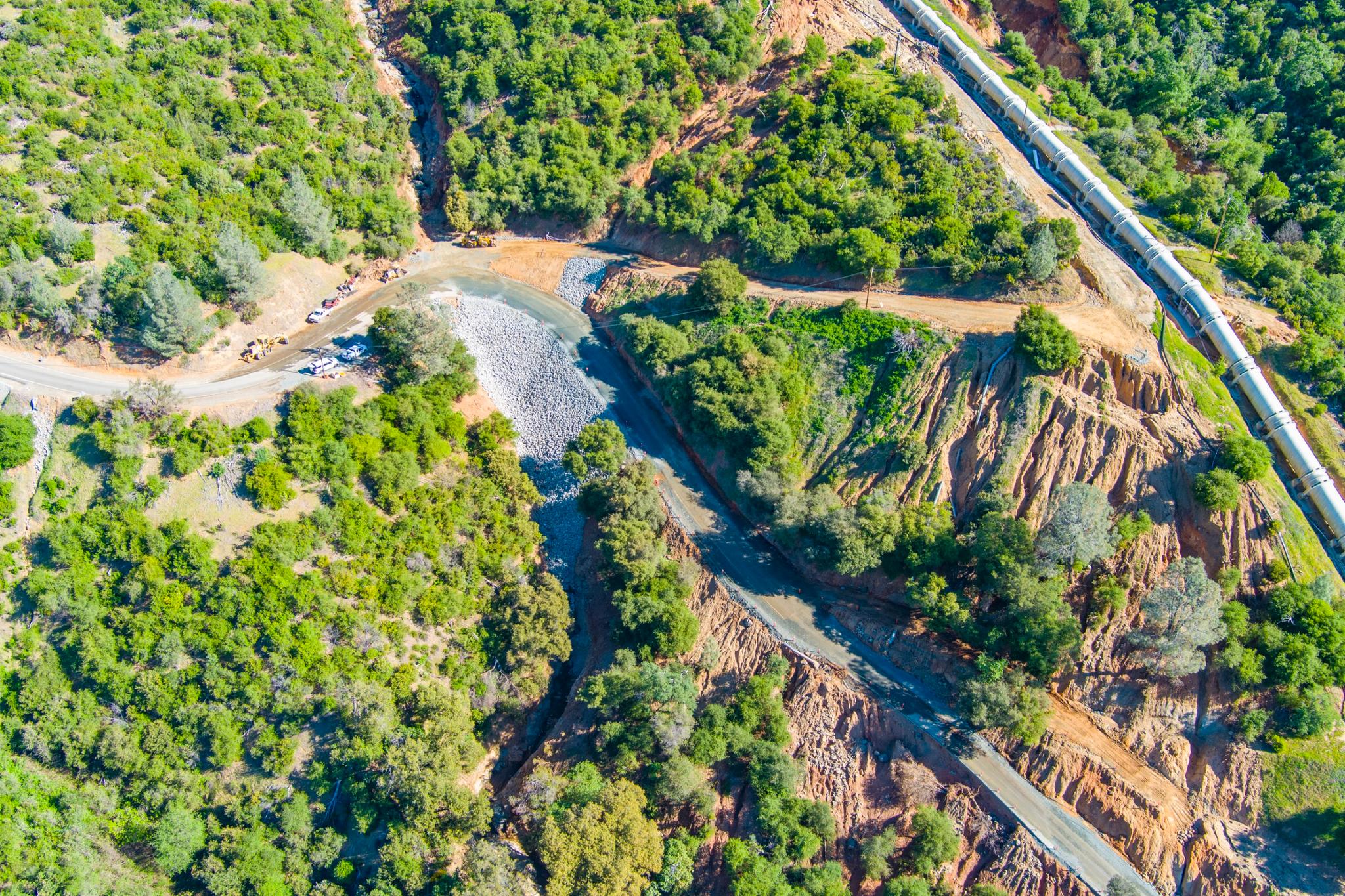
Repairs continue on Lake Francis Road, including reinforcing washed-out sections, installing drainage culverts, and paving. The road remains closed beyond the last residence. Photo: Alex Boesch/Yuba Water Agency.
Lake Francis Road is being rebuilt in phases — utility vehicle access first, then four-wheel-drive trucks, and eventually normal service — with washed-out sections reinforced, drainage culverts installed, and paving scheduled for September and October. The road remains closed to the public beyond the last residence, and the agency says the site is not safe for public access while it is an active construction zone. Planning also continues for stabilizing the hillslope below the penstock, needed both for safe access during the investigation and to keep more sediment out of the river. No schedule has been set for the stabilization work.
The penstock itself is the longest piece of the recovery, and it cannot be designed until investigators finish. A team of independent forensic engineers is still working to determine what caused the pipe to fail; results are expected in the fall, and the agency says no conclusions have been reached about contributing factors.
In May, Yuba Water awarded a contract to GFT Inc. for a condition assessment of the penstock and an alternatives analysis; an initial award the agency put at nearly $2 million, with an estimated $6 million more for detailed engineering design and support during construction. “While this contract does not cover the actual construction of the repaired penstock, it does position us to move quickly once we have the results from the forensic investigation,” said Bryan Perrin, the project manager overseeing the work. “Our goal is to take what we learn from the investigation, develop engineering design plans and award a future construction contract to rebuild the penstock and get us back in business.”
Engineering design is projected to run from August into the summer of 2027, followed by review from an independent board of consultants. No date has been set for construction, and the agency says total cost and schedule depend on the condition assessment and the forensic findings. New Colgate will not generate electricity for the foreseeable future, potentially several years.
Paying for it #
Yuba Water sells its hydropower wholesale to the California Independent System Operator; it has no residential ratepayers and receives no local tax revenue. Response and recovery costs are being covered from the agency’s financial reserves while it evaluates long-term funding options.
In the agency’s June newsletter, Whittlesey wrote that hydropower revenue is “currently significantly reduced.” Yuba Water has paused its sponsorship program, its Community Impact Grant and Loan Program, and other efforts it describes as non-mission-essential. Among the losses is Salmon Expeditions, the rafting field trip offered to every fourth grader in Yuba County; the Yuba County Educational Foundation is raising $161,000 to keep the trips running this year.
Whittlesey also emphasized that New Bullards Bar Dam, about five miles upstream, remains fully operational, and that the dam, spillway, levees, and other flood risk reduction infrastructure in Yuba County were not affected by the rupture. The agency says it retained full control of the dam throughout the incident and can still manage flows during future storms.
Yuba Water posts progress photos, timelines, and updates on the recovery at engage.yubawater.org. The agency says the work will proceed in phases over several years.