Concerns Raised About Herbicide Spraying in National Forest
Debate focuses on wildfire prevention methods, health risks, and alternatives to chemical vegetation control.
4 min read
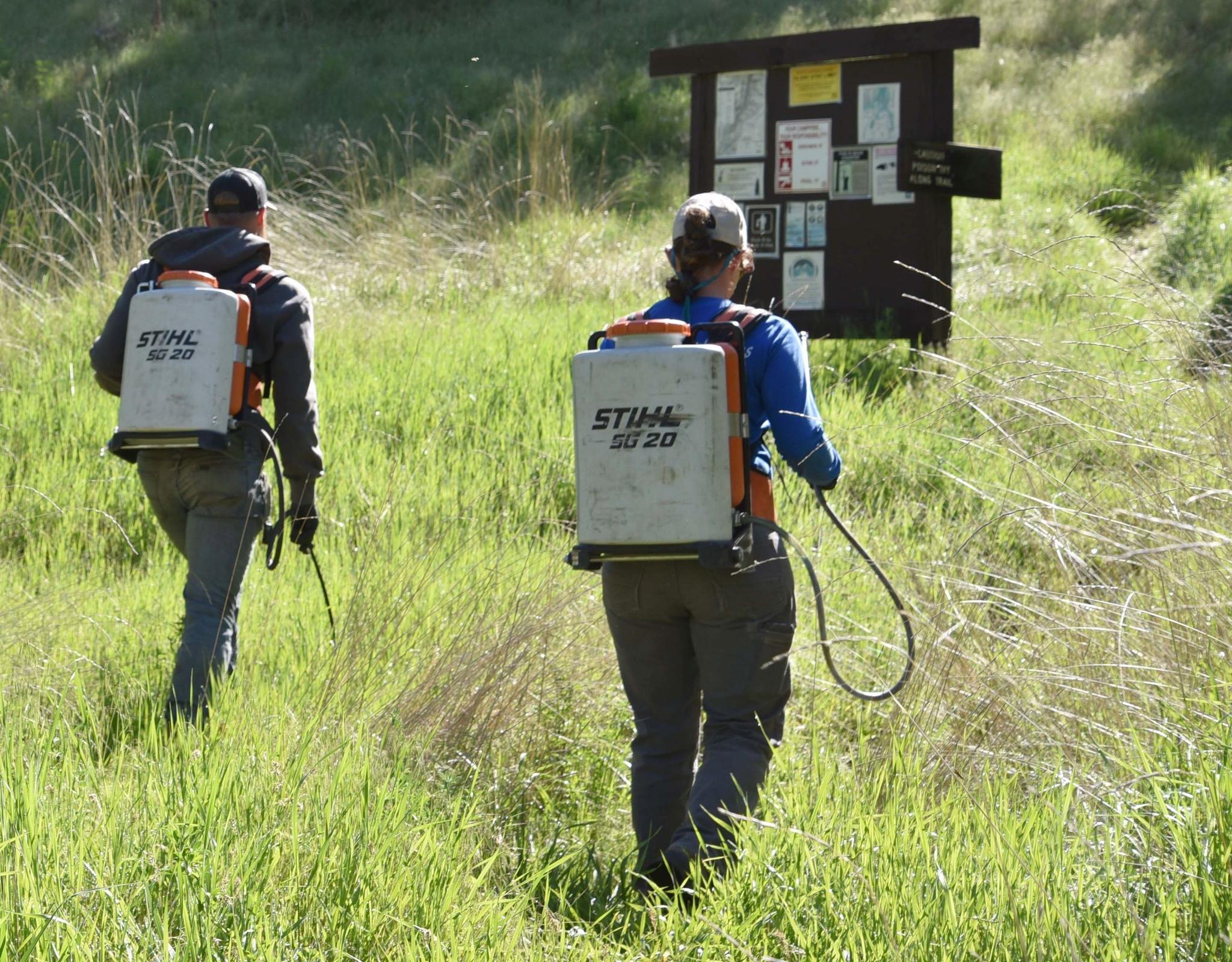
Herbicides are used for invasive plant and noxious weed control in national forests. Credit: U.S. Forest Service.
QUINCY — In a letter submitted to the Plumas County Board of Supervisors and shared with the Mountain Messenger, Josh Hart, Director of Feather River Action!, a Portola-based advocacy group, asked the Board to intervene in plans by the US Forest Service to use herbicides as part of a large-scale wildfire mitigation project in Plumas National Forest.
The Forest Service project at issue, the Community Protection-Central and West Slope Project (CPP), was developed after the North Complex and Dixie fires, with the stated aim of reducing the risk of future catastrophic wildfires. The CPP covers 218,000 acres of Plumas National Forest, including areas along Highways 70 and 89 from Beckwourth and Graeagle to Quincy, and zones near Bucks Lake, Strawberry Valley, and Little Grass Valley Reservoir. According to the Environmental Assessment for the CPP released in June, 2025, the project’s purpose would be achieved through various fuel treatments, including mechanical thinning with heavy equipment, hand thinning, prescribed fire, pile burning, and herbicide application in order to “reduce the accumulation of excessive surface fuels and create sustainable, resilient vegetation structure.”
The Environmental Assessment indicates that herbicides could be applied by hand or vehicle-mounted sprayer to control shrubs and other invasive plants and to prepare burned areas for reforestation. The Forest Service has proposed using seven herbicides (aminopyralid, chlorsulfuron, clopyralid, fluazifop, imazapyr, triclopyr, and glyphosate) for those purposes. The Assessment indicates that herbicides could be applied “as needed…to control shrubs and invasive species” on up to 51,000 acres—nearly a quarter of the total project area. The types and amounts of herbicides to be used on specific locations are not listed, however.
The Board of Supervisors submitted a formal objection in December of 2024 to the plans for herbicide use outlined in a previous draft plan for the CPP. The Board’s letter recommended that chemical herbicides be used only as a last resort and asked the Forest Service to consider using goats and other grazing animals in place of herbicides to control noxious vegetation. Hart, of Feather River Action!, told the Mountain Messenger that the Board’s objection reflected a misunderstanding of the scope of planned herbicide use, which, he alleged, is not merely control of shrubs and invasive plants but “wholesale conversion of wild forests to poisoned tree plantations.”
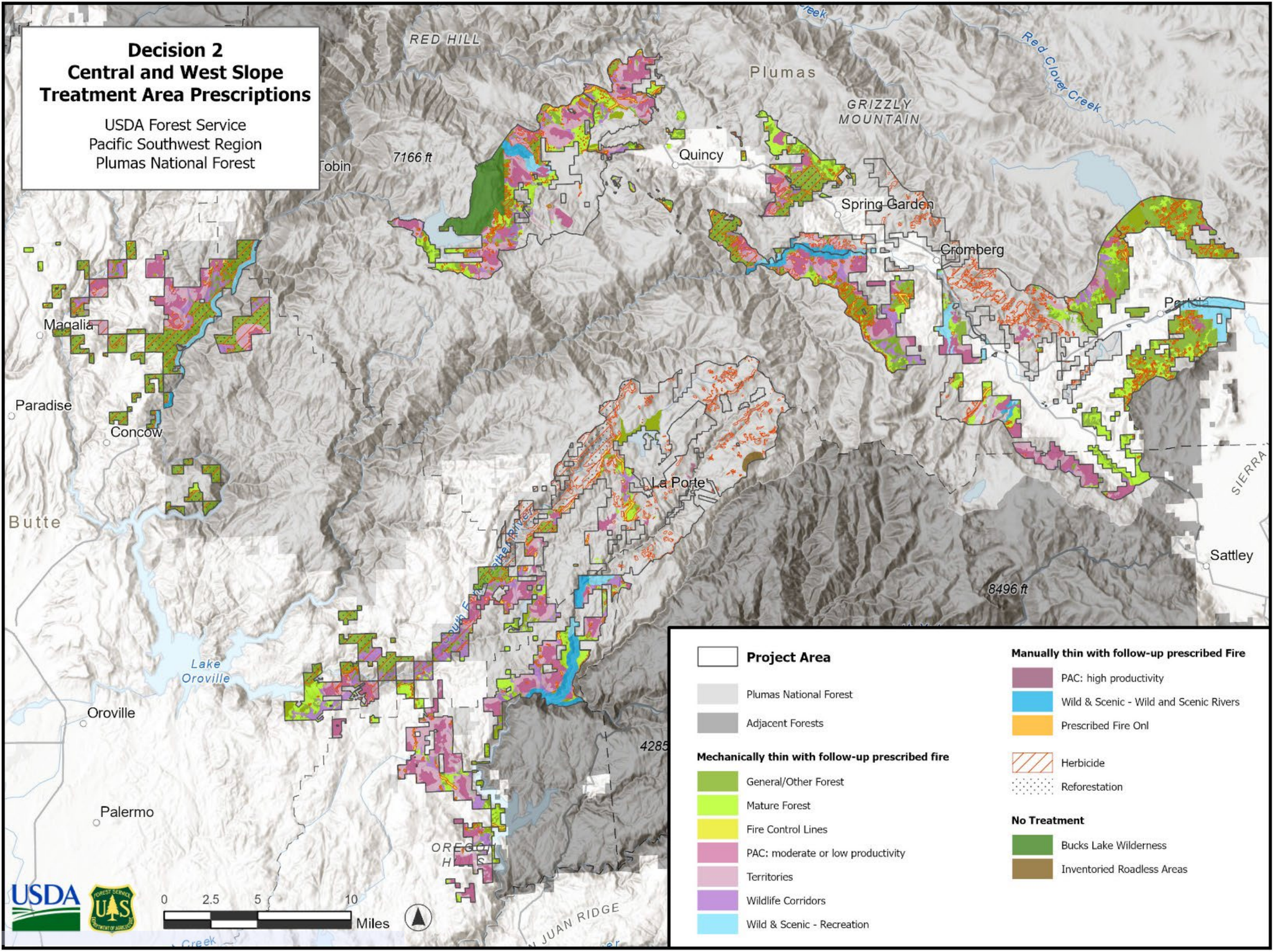
A map of the CPP project area.
Recent reporting by Mother Jones magazine and National Public Radio revealed that areas of Lassen National Forest and private timber lands near Lake Almanor that were burned in the Dixie and Park fires have been sprayed with glyphosate in preparation for reforestation with conifer seedlings. Glyphosate—the active ingredient in Roundup brand herbicides—is classified as a probable carcinogen by the World Health Organization and the California Environmental Protection Agency, but as “unlikely to be carcinogenic” by the federal EPA. While plans for the CPP also refer to potential use of herbicides in areas slated for reforestation, large-scale application of glyphosate in Plumas National Forest has not been confirmed.
Three environmental groups, the John Muir Project, Feather River Action!, and the Plumas Forest Project, have filed a lawsuit against the Forest Service in connection with the CPP. The suit alleges that the project’s true purpose is “to maximize timber extraction, not protect human communities” and charges that the Forest Service’s plans fail to consider alternative approaches to mitigating wildfire risk and violate federal environmental and public land management laws.
Hart presented the substance of his letter at the June 2 meeting of the Plumas County Board of Supervisors. Several other citizens in attendance also expressed concerns about the potential use of herbicides, particularly glyphosate, on forest lands, while expressing general support for wildfire mitigation efforts.
In response to the Mountain Messenger’s email inquiry about plans for herbicide use, Plumas National Forest Public Affairs Officer Tamara Schmidt said, “We do sometimes use herbicides with forestry-specific formulas for things like invasive plant control and reforestation. The decision to use any herbicide, including glyphosate, is made with careful consideration. Before herbicides are applied, the Forest Service goes through a rigorous and multidisciplinary assessment of each chemical and its potential project-specific impacts to meet state and federal laws. Herbicides cannot be applied on national forests without biological review and expert agreement that the data show that herbicide application is the best tool for achieving forest health or restoration.”
If herbicides are used, Schmidt said, signs are posted at access points to treated areas listing the herbicides being used, application dates, and the timeframe during which entry is prohibited.