Hadwick Presses Sacramento for Gray Wolf Action
Ranchers and sheriffs described livestock losses and limited options.
6 min read

Hadwick hosted a press conference on July 1 featuring Sierra County Sheriff Mike Fisher and other community leaders. Credit: Heather Hadwick.
SACRAMENTO — Assemblywoman Heather Hadwick brought ranchers, sheriffs, and rural advocates to Sacramento on July 1 to urge state lawmakers to put more money and more management tools behind California’s gray wolf policies.
Hadwick (R-Alturas) said the return of wolves to Northern California is no longer an abstract wildlife issue for ranching families. She said producers have followed state guidance by using nonlethal deterrents, working with the California Department of Fish and Wildlife, documenting losses, changing grazing practices, hiring range riders, installing fladry, and using drones, but still continue to report livestock losses.
“The wolf crisis is no longer a future concern. It’s happening right now,” Hadwick said at the press conference. “The impacts are real, and they’re growing, and the people living with them deserve to have their voices heard.”
The central message from speakers was not a call to eliminate wolves, but to change how the state responds to conflicts between protected predators and livestock. “The state of California has protected wolves, and it has not provided the resources necessary to manage the consequences of that decision,” Hadwick said. She called for more funding for CDFW, more money for wolf depredation compensation, and policies “that recognize what is actually happening on the ground in rural California.” Gray wolves remain protected under both the federal Endangered Species Act and the California Endangered Species Act.
Sierra County Sheriff Mike Fisher said the word “coexistence” is often used in Sacramento, but rural communities do not believe the current system reflects the meaning of the word. Fisher said ranchers have done what they have been asked to do while wolves have been allowed to continue killing livestock without enough management response.
“My community, like many in the northern state, doesn’t feel like we’re coexisting,” Fisher said. “We feel simply that we are being told to exist with the apex predators.”
Fisher argued ranchers need more authority to haze wolves using nonlethal or less-lethal methods. He specifically mentioned rubber bullets, paintballs, pepper balls, dogs, and the ability to chase wolves out of pastures. Without legal tools for immediate response, Fisher said ranchers are being left to absorb losses while sheriffs and wildlife staff lack the personnel to be everywhere conflicts occur.
Fisher also tied the issue to local law enforcement capacity. He said Sierra County covers about 1,000 square miles with 11 deputies, while the Sierra Valley holds far more livestock than officers can be expected to protect. “We can’t be everywhere,” Fisher said. “We can’t be the ones that are hazing these animals. The ranchers need the tools.”
Siskiyou County Sheriff Jeremiah LaRue said rural communities have been “conveniently overlooked” by much of the Legislature. He said the current approach is not working for residents, CDFW, or the long-term success of wolf recovery.
“This gray wolf situation is not a species recovery success story,” LaRue said. “It is a testament to why a hands-off approach to endangered species management is destined to fail.”
LaRue cited research showing cattle have made up a large share of the diet of California wolves in some study areas. UC Davis researchers reported last year that 72 percent of wolf scat samples tested during the 2022 and 2023 summer seasons contained cattle DNA, with 86 percent of summer 2022 wolf scat samples containing cattle DNA. The researchers cautioned that the data did not show whether wolves killed the cattle, only what the wolves had eaten.
LaRue said ranchers need financial support, deterrence tools, depredation reimbursement, and broader human-wildlife conflict policies. He said the goal is intervention and management, not eradication.
Siskiyou County rancher Shirl Woodson gave a more personal account. Woodson said she and her husband ranch in northeastern Siskiyou County on land established as a ranch in 1862, and she described daily routines now shaped by the presence of the Whaleback Pack.
“When the pack is close to us, the first thing we do after we do chores is we go looking for them,” Woodson said. “We go looking for the deads.”
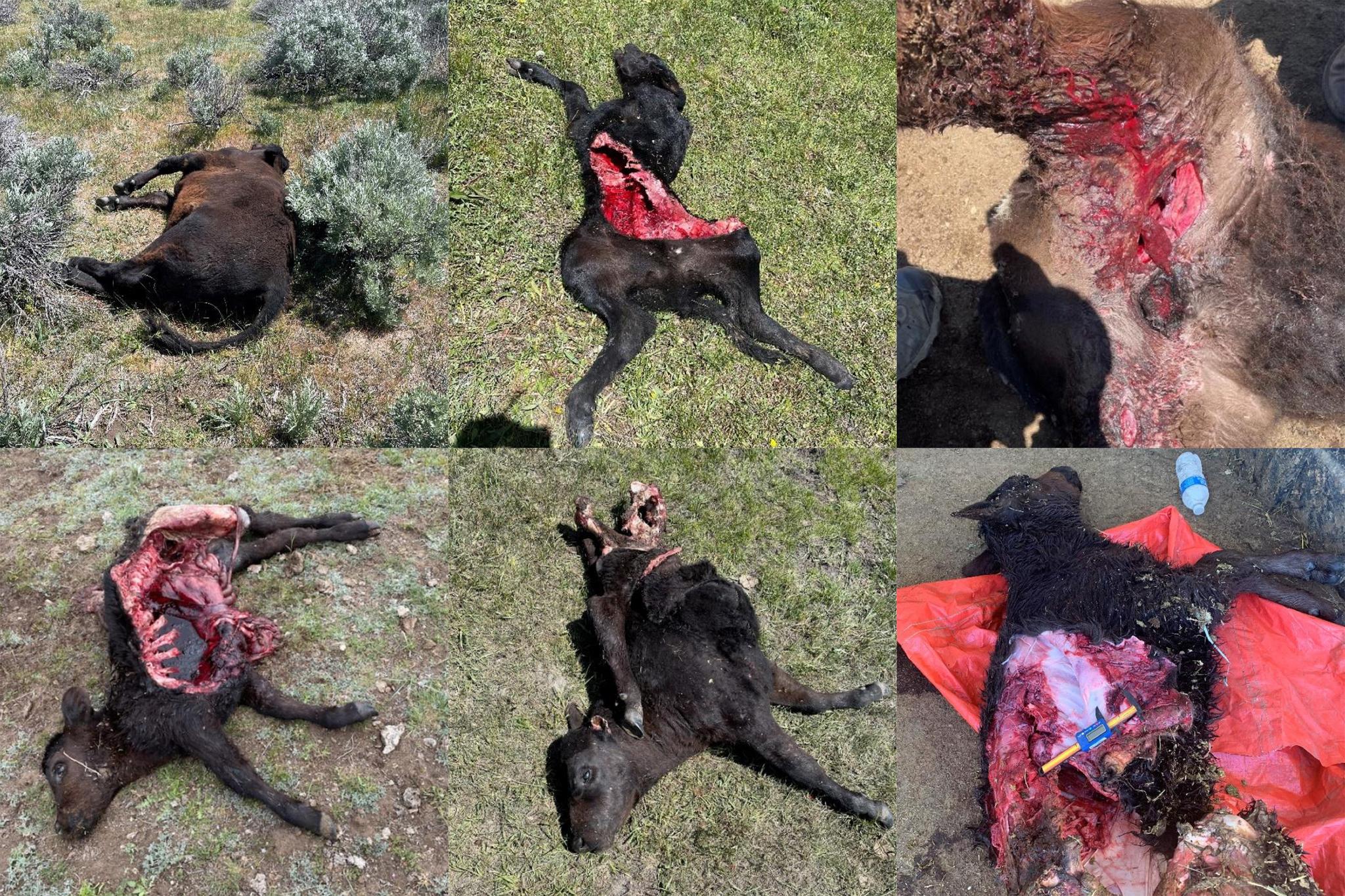
Photographs released by CDFW of some of the confirmed wolf depredations in the Sierra Valley in early 2025.
Woodson said wolf activity has taken time away from ranch work, added stress, and left her fearful around her own home. She described an April 2 encounter in which she said two gray wolves came within about 80 feet of her front door and stalked her dogs. Woodson said she pulled the dogs into the house and has had nightmares about wolves since then.
“We shouldn’t have to live in constant fear,” Woodson said. “And the worst part is this is thrust upon us. This is a home invasion. And we have no resources to help ourselves.”
State Senator Shannon Grove (R-Bakersfield) also spoke in support of Hadwick’s bills and called the issue one of self-defense, property protection, and food production. Grove said ranchers should not have to carry the full financial burden of a state and federal protection system.
“This is about basic self-defense and preventing devastating loss of life, injury, economic losses to our farms and ranches and individuals in rural areas of our state,” Grove said.
Hadwick highlighted two pieces of legislation during the press conference: AB 1722 and AB 1673. AB 1722 would create a defense under the California Endangered Species Act for people who use necessary and reasonable force to protect themselves, family members, or others from immediate bodily harm from a listed species. Hadwick’s office has said the bill does not change federal protections, including federal protections for gray wolves.
AB 1673 began as a bill dealing with county fish and wildlife propagation funds and later became a measure involving wolf aversive conditioning and wildlife coexistence. Hadwick’s office described the bill as allowing livestock producers to use pepper-ball deterrents to haze wolves. The latest bill text refers to CDFW-authorized aversive conditioning on wolves and would allow certain tear-gas projectile weapons with authorization from a sheriff or police chief.
Hadwick said AB 1722 was still moving forward without any “no” votes, while AB 1673 had been killed in the legislature.
Speakers also focused heavily on funding. Hadwick said there is no funding in the current state budget for wolf depredation or coexistence, and her office said a $1 million depredation assistance proposal in the governor’s May Revision was removed from the final budget. CDFW’s wolf-livestock compensation program has received previous state appropriations, including a $3 million pilot program in 2021, $600,000 in 2024, and $2 million in last year’s state budget.
CDFW’s most recent quarterly wolf report for January through March listed 47 livestock depredation investigations, with 21 confirmed and six probable wolf-livestock losses. During the same period, CDFW said the compensation program received 16 new applications covering 34 individual livestock and paid out $179,687.10 for 20 applications.
Hadwick closed the press conference by saying rural communities are asking Sacramento for balance rather than conflict. She said wildlife conservation and support for people who live and work in wolf country should not be treated as opposing goals.
“My commitment is to continue fighting for common sense legislation, funding for the California Department of Fish and Wildlife, funding for wolf depredation, and policies that reflect the realities facing rural California,” Hadwick said.