New Paths Open for Lower Sierra Speed Limits
New law opens review options for Sierra City and Sierraville.
3 min read
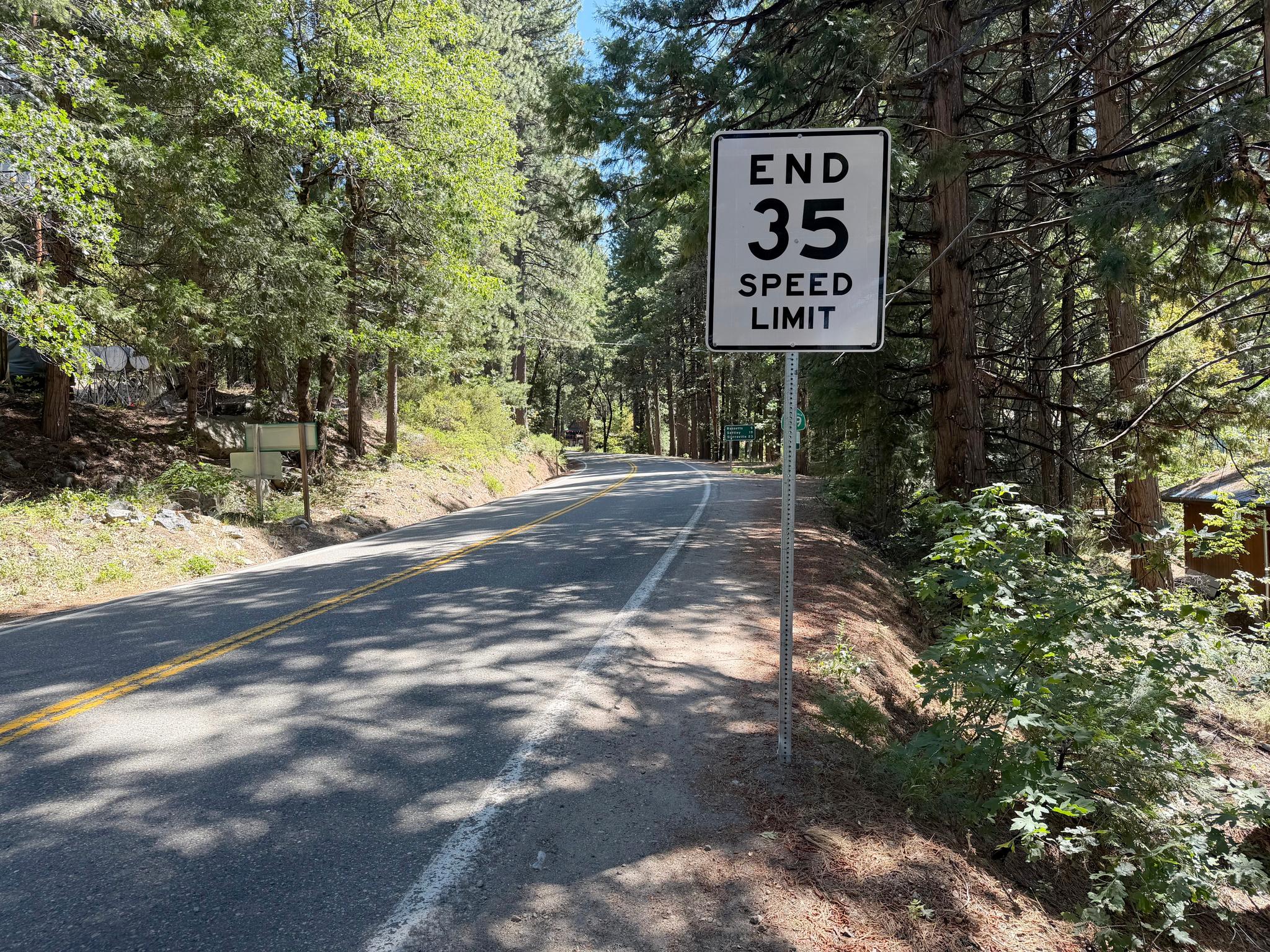
A transition zone created last year in Sierra City allows speeds up to 55 MPH in a residential area. Sierra City residents vehemently opposed the change.
SIERRA COUNTY — New paths to lower, enforceable speed limits on state highways through Sierra City and Sierraville are available under Assembly Bill 1014, giving local officials a reason to revisit recent speed surveys. The law does not change any signs automatically or promise a particular speed, but it creates options that were not available to Caltrans when the earlier surveys were completed. Sierra County Public Works and Transportation Director Josh Handel said he plans to pursue both communities in follow-up discussions with Caltrans.
During the Board of Supervisors’ July 7 discussion, Handel said Caltrans had acknowledged the change in state law. He hoped the agency would consider revising or repeating its surveys in Sierra City and Sierraville. The Board did not select new limits, and no speed change resulted from the meeting.
The opportunity is significant because the 2025 Sierra City review resulted in changes that many residents opposed. It shortened the existing 25-MPH zone, raised a portion near the library to 35 MPH, and changed the former 35-MPH approach from Bassetts into a non-enforceable transition zone. In Sierraville, Sheriff Mike Fisher described a similar problem: a 35-MPH transition zone that cannot be enforced by radar under the current survey.
During a speed survey, engineers record vehicles moving freely through an area and calculate the 85th-percentile speed, the speed at or below which 85 percent of motorists are traveling. State rules normally round that number to the nearest 5 MPH and use the result as the starting point for the posted limit. If the measured speed is 38 MPH, for example, the usual calculation points to a 40-MPH limit. AB 1014, which was signed last October and took effect in January, now allows Caltrans, when the requirements are met, to choose the lower 35-MPH increment instead, preserve or restore an earlier limit, or make an additional 5-MPH safety-based reduction.
For the shortened 25-MPH zone in Sierra City, Caltrans can now reconsider whether 35 MPH is reasonable and whether the survey supports a lower limit. The simplest prior-limit option allows only a 5-MPH reduction, so it cannot by itself move the zone from 35 MPH back to 25 MPH. Reaching 25 MPH would depend either on the survey producing a lower starting point combined with an additional safety-based reduction, or on the area qualifying for the separate business-area provision.
For the Bassetts approach and the Sierraville transition zone, the practical goal would be to establish a lower speed that is supported by a valid survey and can be enforced. Caltrans would revisit the free-flowing traffic data, calculate the 85th-percentile speed, and decide whether the new downward-rounding options apply. Engineers would also review crash history and roadside conditions when determining whether a further reduction is justified. Local concerns about pedestrians, cyclists, school-bus stops, driveways, and the lack of sidewalks can be included, although some special options also require a record of serious crashes.
Another provision could allow a 25- or 20-MPH limit without relying solely on the speed-survey calculation. The road must run through a qualifying downtown-type business area, have sufficiently low limits immediately outside the district, and meet requirements involving features such as storefronts, roadside parking, crosswalks, or stop signs. Whether a portion of Sierra City or Sierraville qualifies is another question the county can raise during the review.
The next step is for county staff to ask Caltrans to reopen the two reviews and determine whether the existing data can be reconsidered or new vehicle-speed counts are needed. Caltrans would then identify which legal option fits each section of highway and prepare a formal speed-zone order if a lower limit is justified. Sierra County can present local safety information, involve CHP, and hold a public hearing if a change is proposed. AB 1014 means lower, enforceable limits in Sierra City and Sierraville are possible, but only after the review establishes the required support and Caltrans approves the change.