On Sierra City’s Community Vision Meeting
5 min read
Editor,
Yesterday I attended one of the most thoughtful and inspiring community conversations I’ve experienced in a long time: the historic preservation and community visioning meeting held inside the Old Sierra City Schoolhouse.
A huge thank you goes to Tom and Shirley Butt for organizing the gathering and opening the beautiful 1883 schoolhouse to the public, along with the Sierra County Historical Society, the presenters, planners, property owners, business owners, and residents who participated throughout the day.
What struck me most was that this was not simply a conversation about preserving old buildings. It became a much broader and more meaningful discussion about Sierra City’s future: economic vitality, tourism, walkability, housing, wildfire resilience, arts and culture, adaptive reuse, safety, and how we can continue moving forward without losing the character that makes Sierra City so special.
Throughout the day, participants discussed ideas such as creating a historic district or preservation overlay, pursuing National Register nominations, exploring Rural Opportunity Zone incentives, improving tourism visibility and digital mapping, streamlining permitting for historic buildings, encouraging adaptive reuse of vacant properties, improving river access and walkability, and finding ways to support year-round business activity.
At the same time, the conversation honestly acknowledged the challenges Sierra City faces today: limited year-round businesses, weak cell service, workforce housing shortages, aging demographics, vacant historic buildings, lack of sidewalks and pedestrian safety downtown, and the ongoing struggle many rural communities face trying to remain economically viable while preserving their identity.
One analogy shared during the meeting by County Public Works Director Josh Handel stayed with many of us. He explained that roads are designed to move people through a place quickly, while streets are designed to support businesses, pedestrians, gathering, and community life. That simple distinction sparked a meaningful discussion about what kind of downtown Sierra City wants to become in the future.
Some of the most memorable moments came from the stories shared by community members. Property owners described the complexity of navigating Caltrans regulations and right-of-way issues involving historic porches and buildings. One speaker jokingly referred to neglected historic buildings being lost through “the deferred method of demolition… by flame,” a sobering reminder of how easily history can disappear when communities lack the resources or tools to preserve it.
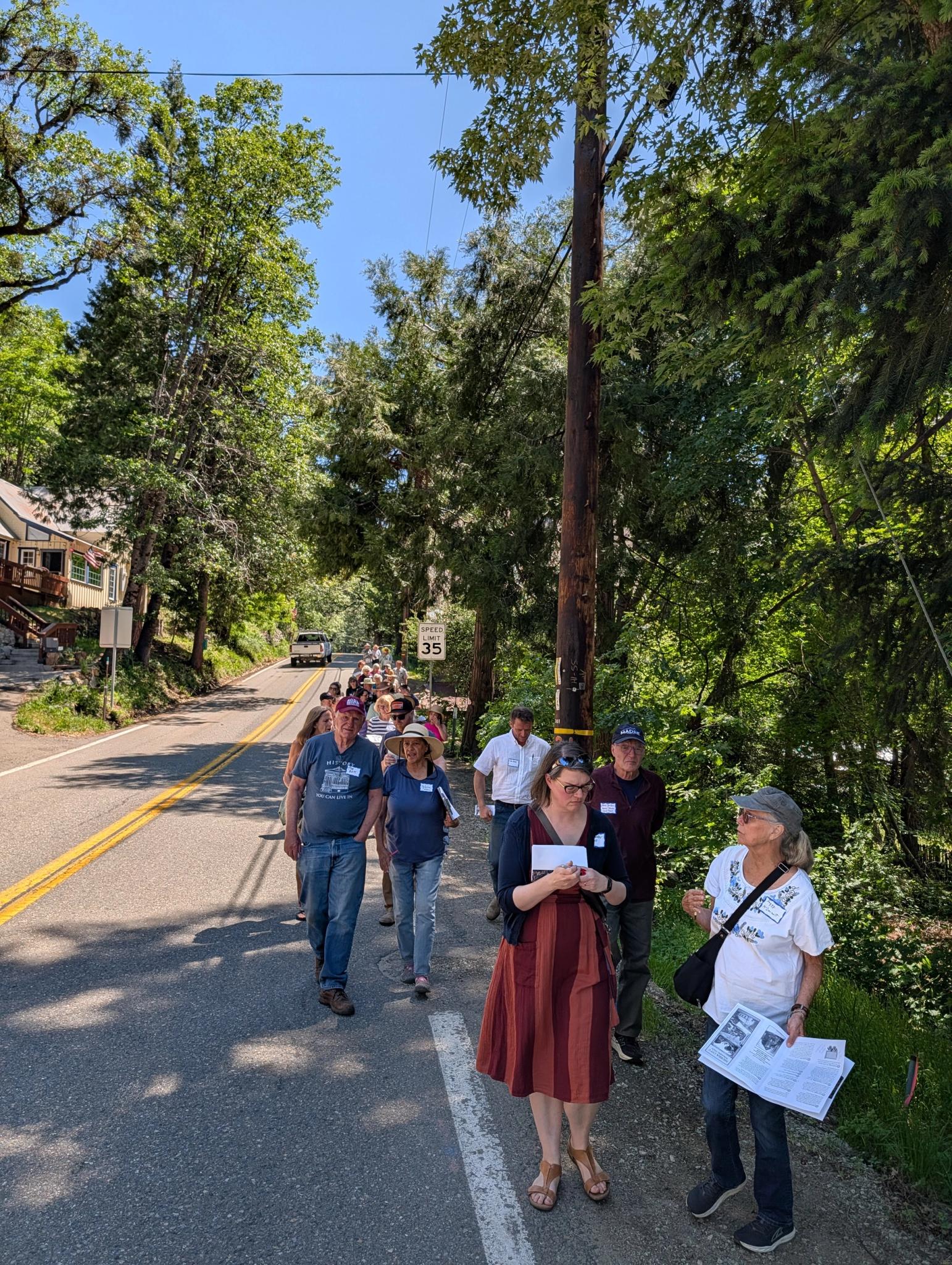
Residents tour Main Street during the workshop. Photo: Sonya Meline.
After the presentations, participants spent over an hour walking through Sierra City together using the Sierra County Chamber of Commerce walking tour map as a guide. We slowed down, looked at the town through fresh eyes, stepped inside several historic buildings, and discussed which structures are most vulnerable, where revitalization efforts could have the greatest impact, and how small improvements over time could strengthen both quality of life and the visitor experience.
One of the most loved and recognizable buildings discussed during yesterday’s meeting was the historic Buckhorn. For many residents and visitors, the Buckhorn is tied to decades of memories: celebrations, dinners with family and friends, live music, laughter, and the unforgettable experience of eating outside on the patio with the creek running right through it. I personally have very fond memories of going there, sharing meals and drinks, and soaking in that one-of-a-kind Sierra City atmosphere. What stood out to me during the meeting was how supportive and hopeful the conversation around the building was. The discussion brought out our community’s genuine appreciation for what the Buckhorn has meant to Sierra City and the shared hope that spaces like this can once again become vibrant gathering places in the future.
Buildings like the Buckhorn are more than structures... they are part of the memories, identity, and heart of Sierra City.
One of the strongest themes throughout the day was that historic preservation is not just about nostalgia. When approached thoughtfully, it can also support tourism, small business development, community pride, and long-term economic vitality.
The discussion also highlighted the incredible role arts and cultural events play in Sierra City’s future. During our walking tour, Chris Stockdale enthusiastically reminded us: “If you want to support Sierra City, come to the music events!” It was a simple but important point. People don’t only visit mountain towns for scenery… they come for experiences, music, culture, history, and community connection.
One of my favorite parts of the day was the postcard exercise, where participants imagined Sierra City 10 years into the future. Despite different backgrounds and perspectives, the visions shared were remarkably similar: restored historic buildings, thriving small businesses, vibrant arts and culture, safer walkability, preserved parks and springs, wildfire resilience, and a community that found ways to create opportunity without overdeveloping or losing its soul.
Personally, one idea that especially resonated with me was the possibility of a community-supported facelift initiative for Sierra City: a collaborative beautification effort such as facade improvements, painting projects, landscaping, signage, and revitalization of public-facing spaces. Small improvements, tackled together, can create visible momentum and renewed pride throughout a community. A small-scale version of this is already happening with a community gardening day at the Sierra City Visitors Center, planned for May 30th at 11am – so no need to wait!
Most importantly, yesterday reminded me how much knowledge, creativity, and passion already exist within Sierra City. The people who live here know this town deeply, care about it fiercely, and should absolutely play a central role in shaping its future.
This is exactly the type of town hall and collaborative community conversation I hope we continue holding regularly not only to share ideas, but to track progress, build momentum, and continue moving forward together.
Sincerely,
Sonya Z. Meline